For millions of commuters across the country, sunset no longer just signals the end of the workday—it marks the beginning of an increasingly stressful and hazardous journey home. In recent years, a quiet crisis has been unfolding on our national roadways, one driven by a technology intended to make driving safer.
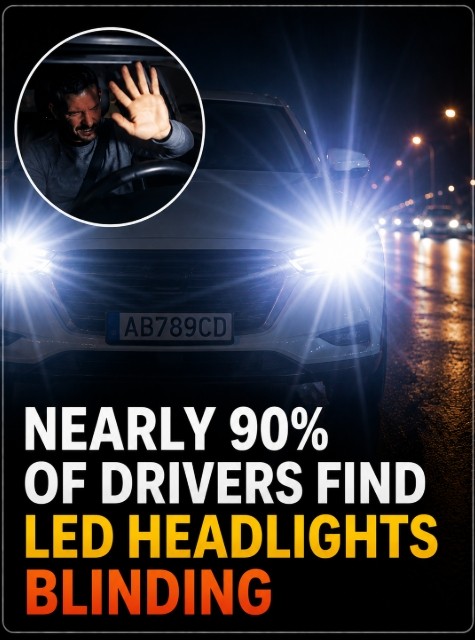
Instead, it has achieved the exact opposite for oncoming traffic. The rapid, widespread adoption of high-intensity LED headlights by major automotive manufacturers has turned night driving into a gauntlet of blinding light. While these ultra-bright systems provide unprecedented visibility for the person behind the wheel, they simultaneously inflict severe, temporary blindness on every other driver sharing the asphalt.
Recent consumer safety surveys reveal that an overwhelming majority of motorists—nearly 90 percent—now explicitly identify modern LED headlights as a primary hazard. The issue isn’t just a minor inconvenience or a matter of personal discomfort; it represents a significant safety deficit.
When an oncoming vehicle equipped with factory-grade LEDs approaches, the intense, cool-toned blue-white light instantly overwhelms the human retina. This creates a phenomenon known to experts as “discomfort glare” or “disability glare,” which causes a temporary loss of visual clarity. During those few crucial seconds of exposure, a driver’s ability to discern lane markings, spot pedestrians walking on the shoulder, or react to sudden obstacles drops to zero.
The physical toll of this automotive trend extends far beyond the moment of impact on the road. Drivers with common vision conditions, such as astigmatism, report that the piercing quality of LED illumination makes the roadway completely unreadable, causing the light to scatter into a disorienting web of sharp halos.
Furthermore, smaller sedan drivers suffer disproportionately when followed by lifted pickup trucks or large SUVs, as the high-placed headlights beam directly into rearview and side mirrors, filling the vehicle’s interior with a blinding reflection. Despite growing public outcry and tens of thousands of signatures on national petitions demanding immediate federal regulation, current safety standards continue to legalise these factory-installed lights.
Until transportation authorities address the severe imbalance between a single driver’s visibility and collective road safety, driving after dark will remain an increasingly treacherous gamble for nine out of ten motorists.