The Day Everything Changed
I remember the silence most vividly. It wasn’t the kind of silence that precedes a storm, but the kind that signals the definitive end of something vital. My baby, Henry, was only three hours old, his breathing soft and uneven against my chest, when the doctor explained the diagnosis: motor impairment, a long road of uncertainty, and a lifetime of specialized therapy.
I nodded, absorbing the news with a detached, mechanical clarity, trying to process what this meant for our future. Beside me, my husband, Warren, didn’t offer a hand to hold or a word of comfort. Instead, he stood up and reached for his car keys.
I initially thought he was just stepping out for a moment of air; he had always been a man who retreated when the world became too heavy. But he didn’t move toward the door with the purpose of a man needing space. He looked at our newborn son as if he were auditing a damaged product, weighing the cost against the benefit.
“I’m not doing this,” he said, and with that single, cold declaration, he walked out of my life. He didn’t slam the door; he simply closed it, and the distance between my old life and my new reality became infinite. I was left alone in that sterile room, staring at the small, fragile bundle in my arms, and I made a silent vow that I would be enough for both of us.
The years that followed were an endless marathon of struggle. I learned to stretch muscles while my own hands shook with exhaustion; I learned how to battle heartless insurance companies and maintain a brave face for a world that treated my son’s condition as a tragedy.
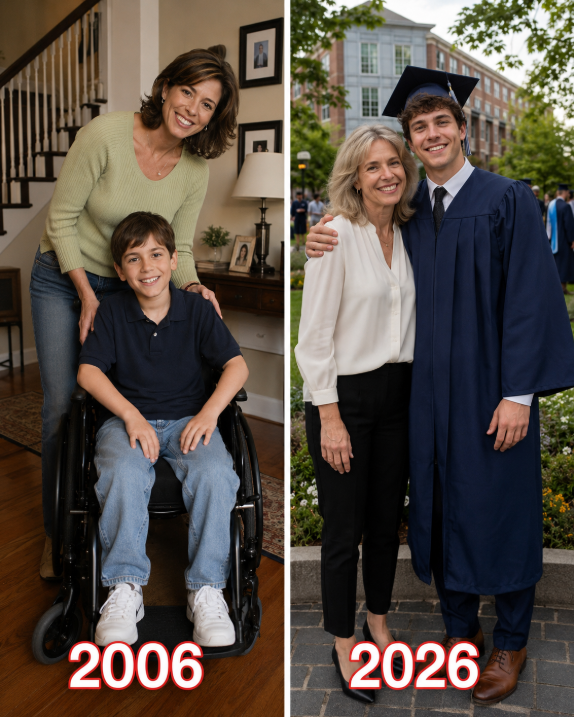
People in town looked at us with a pity I learned to despise. But Henry refused to be a tragedy. He grew up with a stubborn fire that mirrored my own. By the time he reached medical school, he didn’t just understand his condition—he had mastered the system that tried to limit him. He wasn’t just a patient; he was an advocate.
Then, twenty-five years after he left, Warren returned, wanting to bask in the reflected glory of a son he hadn’t raised. Henry invited him to graduation, and as Warren stared at the man Henry had become, he didn’t see a miracle of perseverance—he saw a man he hadn’t the courage to be.
Warren expected to be welcomed, but Henry had other plans. He didn’t invite his father there to make amends; he invited him there to witness the truth of his absence.