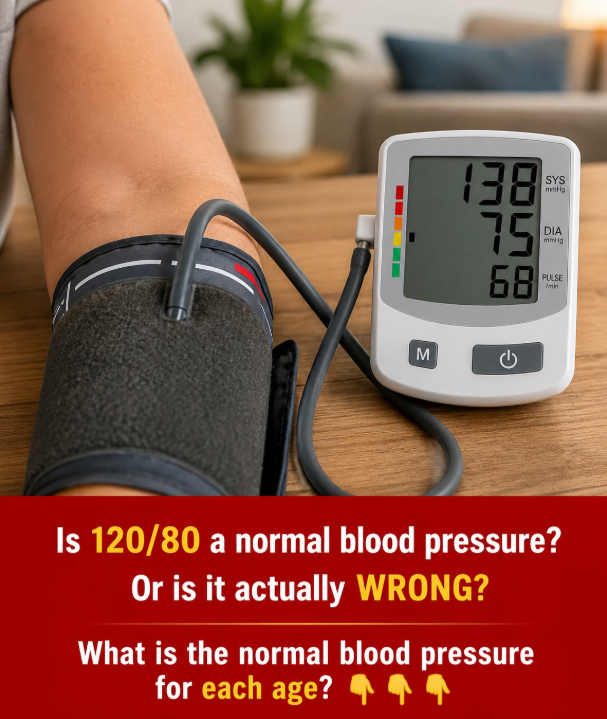
For decades, an unwritten rule circulated through family medicine and household wisdom alike: as you get older, your blood pressure numbers are naturally supposed to go up. Many people grew up believing that a higher reading was completely normal for a senior citizen compared to a young adult in their twenties. It sounded logical enough—arteries stiffen over time, so the body must require more force to move blood.
However, major health organizations, including the American Heart Association and the American College of Cardiology, have issued a massive reality check. The old charts that adjusted your ideal reading based on the year on your birth certificate are officially obsolete.
Modern clinical guidelines have completely abandoned age-based normal ranges. Instead, a strict, unified standard now applies to every single adult, whether they are 25 or 85 years old. According to current medical consensus, normal blood pressure is defined as a systolic reading of less than 120 mm Hg and a diastolic reading of less than 80 mm Hg.
The moment those numbers start creeping higher, the clinical risks begin, regardless of how many birthdays you have celebrated.
Why did the medical community decide to completely throw out the old age-based system? The answer comes down to years of intensive, large-scale clinical data. Studies following thousands of patients revealed a harsh truth: letting blood pressure rise just because a patient is older does not protect them.
In fact, it does the exact opposite. High blood pressure causes the same damage to blood vessels and organs whether you are young or old. Allowing older adults to maintain higher readings under the assumption of it being “age-appropriate” directly led to higher rates of avoidable strokes, heart attacks, and kidney damage.
Furthermore, recent updates place an even greater emphasis on the long-term impact on brain health. Consistently elevated pressure puts immense strain on the delicate blood vessels in the brain, which is a leading contributor to cognitive decline and vascular dementia later in life. By keeping the target uniform and treating elevation early, doctors can significantly reduce these neurological risks.
Under the current framework, anything from 120 to 129 systolic over less than 80 diastolic is classified as elevated. Once a reading hits 130 over 80 or higher, it is officially diagnosed as Stage 1 hypertension. This uniform threshold ensures that patients receive proactive lifestyle interventions or medication management before permanent cardiovascular damage occurs. The takeaway is incredibly clear: you cannot blame a high reading on your age anymore.
Protecting your heart, brain, and kidneys means aiming for the exact same healthy target throughout your entire adult life. If you are still relying on an outdated chart that gives your numbers a pass just because you’ve reached a certain milestone, it is time to discard it and talk to a professional about what a truly healthy reading looks like today