The graduation grass was still beneath Nora’s hands when the three young women gathered around her and revealed the folders they had carried beneath their gowns. She had expected a thank-you, maybe a quick snapshot by the bleachers, or a few words about the two decades she spent raising them alone. She never expected to see her own last name written across all three official documents.
Twenty years earlier, Nora’s life changed on an ordinary Tuesday morning.
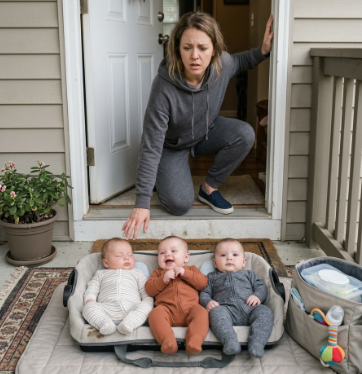
There were no warnings, no long conversations, no chance to prepare. Her younger brother had dropped three six-month-old triplet babies on her front doorstep, leaving them sitting in a single wide carrier accompanied by one overstuffed diaper bag and a short note scribbled on the back of a grocery receipt.
“Nora, I can’t do this. Take care of them.”
That was all she had.
The first night was an endless blur of bottle warming, laundry piles, crying, and absolute exhaustion. One baby needed feeding while another spiked a fever. The third finally fell asleep against her shoulder while Nora sat upright in a worn armchair, wondering if her brother would come back and admit he had made a terrible mistake.
The driveway stayed empty.
The next morning came, and Nora faced a stark choice. She could wait for someone else to rescue the situation, or she could become the person those three little girls needed to survive.
She chose them.
Over the years, Nora learned every single aspect of parenting without ever demanding the title. She learned how to carry three sleeping toddlers inside at the same time. She learned how to stretch groceries when money was dangerously tight, how to fix broken toys, and how to show up for every school play and parent-teacher conference even when she was exhausted down to her bones.
She sat through midnight fevers. She helped with math homework at the kitchen table. She sat alone in school bleachers where other families had two parents cheering, making sure those girls always saw at least one person who never missed a single moment.
The girls never called her Mom. Nora never asked them to. She was their aunt, and she believed love did not need to force a title onto itself.
When they eventually grew old enough to ask about their father, Nora did something many people would have struggled to do. She told them the truth without turning their father into a villain. She showed them the faded grocery receipt she had kept safe for two decades.
One of the girls read the scrawled message twice. “You kept this all this time?” she asked softly.
Nora looked down at the paper. “I didn’t know what else to do with it.”
The girl carefully handed it back. “Then keep it.”
That moment stayed with Nora for years—not because it erased the sting of abandonment, but because it proved they understood.
The years flew by. The three triplets grew into sharp, independent young women with distinct personalities, fierce arguments, and high-reaching dreams. They borrowed each other’s clothes, fought over bathroom space, studied late into the night, and finally reached the exact same milestone: college graduation day.
Nora told herself getting them across the finish line was reward enough. She did not need a grand speech. She did not need public recognition. She only needed to know they were ready for the world.
Then, one week before graduation, an unexpected message arrived on the oldest sister’s phone from the man who had vanished twenty years earlier.
“I want to be there. I’m still their father.”
Nora refused to hide it. She handed the phone to the girls and let them decide. The oldest read the message, looked at her sisters, and nodded. “Let him come.”
Graduation day arrived under a bright, cloudless sky. Families filled the stadium, cameras flashed, and graduates in dark robes walked across the stage. Nora sat in the middle rows, clapping until her palms stung, remembering three tiny car seats on her front step.
After the ceremony, as the crowd shifted, Nora’s brother appeared out of nowhere. He looked like a man who genuinely believed two decades of absence could be wiped away with a single afternoon smile.
“Come here, girls,” he said, stepping in with his arms open wide. “Let’s get a family picture.”
The middle sister stepped directly in his path. “A family picture?”
His expression faltered. “I’m your father. Whatever happened between me and your aunt doesn’t change blood.”
Nora stepped back, wanting the choice to remain entirely theirs. But the youngest sister grabbed Nora’s wrist, anchoring her in place.
“Aunt Nora. Stay right here.”
Their biological father looked down at the hand holding Nora’s arm, his irritation showing. “You’ve had them long enough. Don’t make this harder than it needs to be.”
Nora kept quiet, letting the young women speak for themselves.
The oldest sister looked squarely at the man who had left them on a doorstep. “You left three babies in a basket.”
Her sister pointed toward Nora. “She stayed for every single day after that.”
The youngest sister unzipped her graduation folder and pulled out three crisp legal envelopes. She handed one to Nora.
Inside were not graduation certificates, but official court-stamped name-change documents. Months earlier, all three sisters had legally dropped their birth surname and adopted Nora’s last name. They had chosen the name of the person who packed their lunches, dried their tears, and never walked away.
Nora’s knees buckled slightly on the grass, overwhelmed by a wave of emotion she couldn’t contain. The three sisters dropped down beside her, wrapping their arms around her shoulders.
“You never asked us to call you Mom,” one whispered against her cheek.
“You never asked us to owe you anything,” another said.
“You just stayed.”
Behind them, their biological father stared in disbelief. “You can’t just erase who your father is.”
The oldest sister stood up, holding her diploma in one hand and the legal decree in the other. “We aren’t erasing anybody. We are simply choosing what—and who—actually belongs to us.”