“You told me he lost it overseas.”
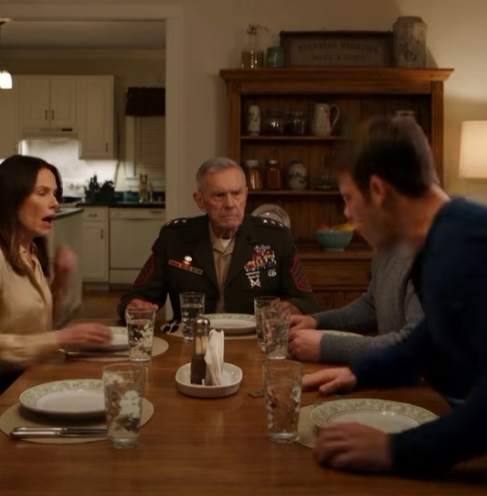
Nathan dropped the watch onto the dinner table.
It landed beside his grandfather’s plate with a sharp metallic sound.
Across the table, his mother lowered her fork.
“Nathan—”
“It was in his desk, Mom. Wrapped in a cloth. All these years, it was right here.”
His grandfather, Colonel William Hayes, looked down at the watch.
He was still wearing his dress uniform from the memorial ceremony that afternoon. Beneath the dining room light, the ribbons on his chest looked brighter than anything else in the room.
Nathan had always hated how easily people spoke to his grandfather about his father.
They shook William’s hand. They remembered places, dates, names.
Nathan remembered a man lifting him onto his shoulders.
Then a funeral.
He had been five.
“Why did you hide it?” Nathan demanded.
William placed his napkin beside his plate.
“Sit down.”
“No. Tell me.”
His mother reached for his arm, but Nathan stepped away.
Every year, they told him something different.
When you’re older.
When your grandfather is ready.
Some things are difficult to explain.
He was twenty-four now.
He had grown tired of being the youngest person in every conversation about his own father.
William pushed back his chair and stood.
“Your father gave me that watch before he left.”
Nathan stared at him.
“Then why did you say he lost it?”
“Because I didn’t know how to explain why he’d left it behind.”
“So you lied.”
“Yes.”
The answer came without hesitation.
Nathan had expected an argument. The quiet admission unsettled him more.
William rested one hand on the back of his chair.
“He knew his next assignment would be dangerous. He didn’t want the watch damaged. It had belonged to my father before it belonged to him.”
Nathan looked at the scratched silver case.
“He wanted me to keep it for you.”
“Then why didn’t you give it to me?”
William glanced toward Nathan’s mother.
She was crying silently.
“He left something else,” William said.
He reached inside his uniform jacket and withdrew a folded envelope.
Nathan recognized his father’s handwriting from the birthday cards his mother kept in a box.
His name was written across the front.
For Nathan.
“Your father asked me to give you this when you were grown.”
“You’ve had it all this time?”
William nodded.
“I planned to give it to you after the ceremony today.”
Nathan let out a short, disbelieving breath.
“After nineteen years, today was finally the right day?”
“No,” William said. “There were other days. Your eighteenth birthday. Your graduation.”
“Then what stopped you?”
His grandfather looked down at the envelope.
“Every time I took it out, I remembered the night he gave it to me. And I put it away again.”
For the first time that evening, William’s voice faltered.
“I kept telling myself I was waiting for you to be ready. I was waiting for myself.”
Nathan took the letter.
Nobody spoke as he opened it.
Hey, little man,
Right now, you’re asleep upstairs with one sock on and that green truck in your hand. You insisted on sleeping with it because you thought I might need a ride when I got home.
Nathan sat down.
He remembered the truck.
One front wheel had been missing. He had carried it everywhere.
If you’re reading this, there are things I didn’t get to do with you.
I didn’t get to teach you to drive. I didn’t get to watch you fall in love, or hear what you decided to do with your life.
I wish I could tell you exactly what kind of man to become. But I think that’s your decision.
You don’t have to be a soldier because I was one.
Nathan stopped reading.
For the past six months, he had been preparing an application for officer training.
He had barely discussed it with his mother.
William knew nothing about it.
If you choose that life, make sure you want it for yourself. And if you choose something else, you haven’t let me down.
Your grandfather may tell you I was brave. He’s my dad, so he’ll leave out a few things. Ask him about the time I crashed his car into the garage.
An unexpected laugh escaped Nathan.
William covered his mouth.
“I told him that story was staying between us.”
Nathan looked up.
“You let him drive your car?”
“Against my better judgment.”
“What happened?”
“He confused the pedals. Then tried to blame the garage.”
His mother laughed through her tears.
For a moment, Nathan could picture him: young, embarrassed, arguing beside a dented car.
He returned to the letter.
Take care of your mother. But remember she gets to take care of you too.
And talk to your grandfather. When he gets quiet, he usually has something he needs help saying.
I love you, Nathan. I loved you before you could talk, before you could walk, before you ever did a single thing to make me proud.
Dad.
Nathan read the last lines twice.
Then he folded the letter carefully.
“I wanted to know him,” he said.
William nodded.
“I know.”
“No. I wanted to know more than how he died.”
His grandfather pulled out the chair beside him.
“You’re right.”
Nathan picked up the watch.
“Does it work?”
“It needs winding.”
William showed him how.
Afterward, Nathan left his chair beside his grandfather’s.
The dinner went cold while William told him about the ruined garage door, a disastrous fishing trip, and the afternoon his father had first brought Nathan home.
This time, when his grandfather paused, Nathan waited.
And William kept talking.