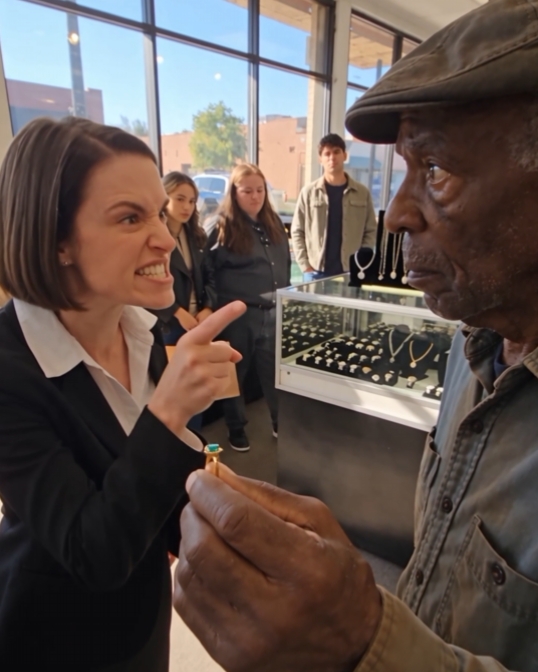
What happens in the video:
An elderly man in a worn beige jacket stands in a jewellery showroom using a walking stick. He holds up a small item while speaking to a suited employee, who gestures and leans towards him. Another older suited man approaches and reaches towards their hands near the end. The clip does not identify the object or reveal the outcome.
Continuation:
George had found the cufflink while clearing the last drawer in his brother’s house.
At first, he thought it was an ordinary piece of costume jewellery. Then he recognised the scratched initial on the back.
Their father’s.
He took it to the shop because he wanted a matching piece made for his nephew’s wedding.
The assistant glanced at it.
“We don’t carry that design.”
“I know. I was hoping—”
“Our current collection is over there.”
George looked towards the display, then back at the cufflink.
“I don’t want a different pair.”
The employee interpreted his insistence as a complaint. George heard impatience and became more determined to explain.
An older jeweller noticed the exchange and joined them.
“May I see?”
George placed the cufflink in his palm.
The jeweller turned it over carefully.
“We might be able to make a companion piece. It wouldn’t be identical in age or wear.”
“That’s all right.”
George explained that the original pair had belonged to his father. His brother inherited them, wore them at every important occasion, then lost one years before he died.
His nephew had assumed both were gone.
“I’d like him to have something of his father’s on the day.”
The assistant looked down.
“I’m sorry. I was showing you what we sell instead of listening to what you needed.”
George accepted the apology, then asked about the practicalities.
The jeweller prepared a design that echoed the surviving cufflink without pretending to be an antique. He suggested a small inscription on the back of the new one.
George chose his nephew’s initials.
When the pair was ready, the difference between them was subtle but visible. One carried decades of wear. The other waited for its own history.
At the wedding, George handed over the box while the groom was struggling with his sleeves.
His nephew recognised the old cufflink immediately.
“Dad wore these.”
“One of them,” George said. “The other’s yours.”
For a moment, the young man couldn’t speak.
Then he asked George to help fasten them.
During the reception, someone photographed them standing together, the groom’s wrist resting on his uncle’s shoulder.
George later took a copy to the shop.
The assistant remembered him and asked how the wedding had gone.
George placed the photograph on the counter.
“See for yourself.”
They studied it together. The cufflinks were barely noticeable, but George’s nephew was smiling broadly.
Before leaving, George tucked the photograph safely into his jacket.
The jeweller had offered to display a copy. George agreed, provided the family approved.
It was a story worth asking about before making assumptions.