What happens in the video
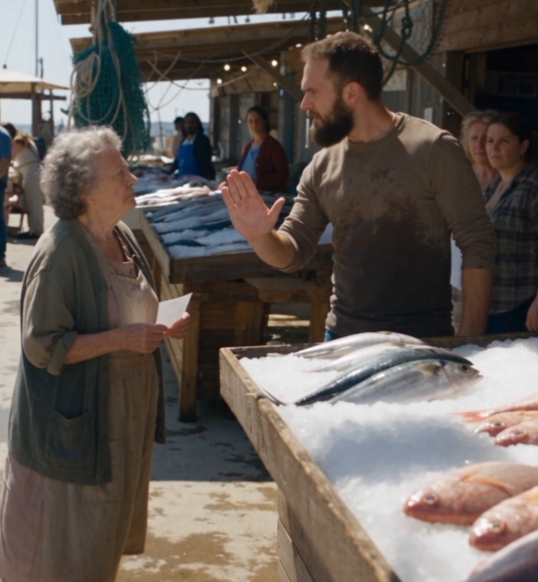
An elderly woman approaches an outdoor fish stall holding a small piece of paper. A younger, bearded man behind the counter raises his hand and repeatedly points away as she tries to show it to him. She stays beside the fish display and continues holding out the paper while people nearby watch. Towards the end, a uniformed officer approaches. The clip ends before we learn what is written on the paper or how the confrontation is resolved.
Continuation:
Martha had checked the address three times before leaving home.
For years, her husband had done the shopping at the harbour. Every Friday, he returned carrying fresh fish and a story about someone he had met. Since his death, she had avoided the market. Even the thought of walking past their favourite stalls made her hesitate.
But that morning, she had found something tucked inside his old shopping bag: a receipt marked PAID — COLLECT FRIDAY.
Beneath it, in his handwriting, were three words.
For Martha’s birthday.
She stood in her kitchen holding the paper for a long time. Then she put on her cardigan and went to the harbour.
The young man at the stall barely glanced at the receipt.
“That’s from months ago.”
“I know,” Martha replied. “I wondered whether—”
“We can’t keep orders forever.”
She tried again, lifting the paper, but he pointed towards the other stalls. Customers were waiting, and he wanted the conversation finished.
Martha felt her face grow hot. She hadn’t come expecting months-old fish. She wanted to know what her husband had ordered. Perhaps it was something she could buy again. Perhaps, for one evening, she could finish a plan he had never lived to complete.
When the officer approached, the young man immediately began explaining.
“She keeps asking about an old order.”
The officer turned to Martha.
“May I see?”
She handed over the receipt.
“My husband bought it,” she said. “He died before he could collect it.”
The young man’s pointing hand dropped.
Behind him, an older worker stepped out from the shade. Hearing her husband’s name, he came closer.
“You’re George’s wife?”
Martha nodded.
The worker remembered him. George had ordered sea bass, carefully explaining how his wife liked it prepared. He had even asked which vegetables would go best with it.
“He said you’d cooked for him for forty-three years,” the worker told her. “He wanted to manage one proper birthday dinner himself.”
Martha pressed her lips together, but the tears came anyway.
The younger man looked down at the receipt.
“I’m sorry. I should have let you finish.”
“Yes,” she said quietly. “You should.”
He didn’t offer an excuse. Instead, he asked whether she would like him to prepare the same order.
That evening, Martha invited her daughter over. Together, they followed the older worker’s instructions, laughing when neither could decide whether George would have remembered to turn the oven on.
Before they ate, Martha placed the receipt beside her plate.
For the first time in months, remembering her husband brought something besides the pain of losing him.
It brought dinner, company, and a story she hadn’t heard before.