What happens in the video
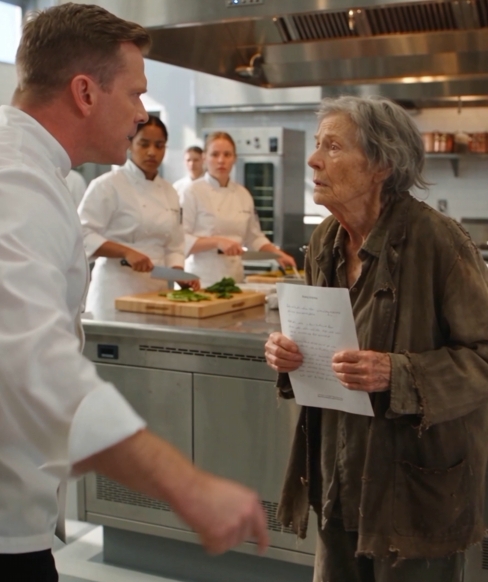
An elderly woman in worn brown clothing stands in a commercial kitchen holding a sheet of paper. A younger chef approaches, leans towards her, and gestures during an apparently heated exchange. Other kitchen staff watch. A second chef comes forward near the end and addresses them. The document and the visitor’s purpose are not revealed.
Continuation:
The paper had softened where Evelyn kept folding it. She had written the quantities in large letters because her old recipe book had become difficult to read.
A restaurant apprentice had contacted her through a neighbourhood project. They were collecting recipes associated with the area, and he wanted to learn the stew her family had made for decades.
He had told her to ask for him at the back entrance. Unfortunately, he had forgotten to tell the lunch team she was coming.
Evelyn stepped into the kitchen holding the recipe. A chef immediately crossed towards her.
“You can’t stand here.”
“I’m looking for Paul. He asked me—”
“We’re working.”
Evelyn moved away from the preparation counter. She understood that kitchens were busy places. What she didn’t understand was why the man wouldn’t let her finish one sentence.
His name was Ross. Orders were waiting, somebody had called in sick, and he had decided the unexpected visitor was a problem to remove rather than a person to understand.
He pointed towards the door. Evelyn folded the paper against her chest.
Another chef, Martin, noticed the exchange and came forward.
“Who are you here to see?”
This time, she was allowed to answer.
Martin recognised Paul’s project and brought Evelyn to a quieter space outside the working kitchen. He found the apprentice, who arrived looking mortified.
“I should have arranged this properly. I’m sorry.”
Evelyn sat down. “You could start by telling me whether you still want the recipe.”
“Very much.”
They rescheduled the cooking session for a quiet morning. Before she left, Ross came out to apologise. Martin had spoken with him privately about his conduct, but Ross’s words were his own.
“I needed you away from the work area. I didn’t need to speak to you like that.”
Evelyn accepted the distinction. “Next time, tell me where I can wait.”
When she returned, there was a chair ready and Paul had an apron for her. She explained why the onions needed time and how her mother stretched the dish when unexpected visitors arrived.
Ross was preparing vegetables at the next bench. After a while, he asked whether he could taste the finished stew.
Evelyn handed him a spoon.
“It needs something,” he said cautiously.
“It needs another ten minutes.”
He waited. She was right.
The restaurant later served the dish at a community supper, crediting Evelyn and printing the recipe with her permission. She brought two friends, both of whom insisted their own mothers had made a better version.
Evelyn laughed and asked for bread.
Across the room, Paul checked that every guest had somewhere comfortable to sit before he returned to the kitchen.