What happens in the video
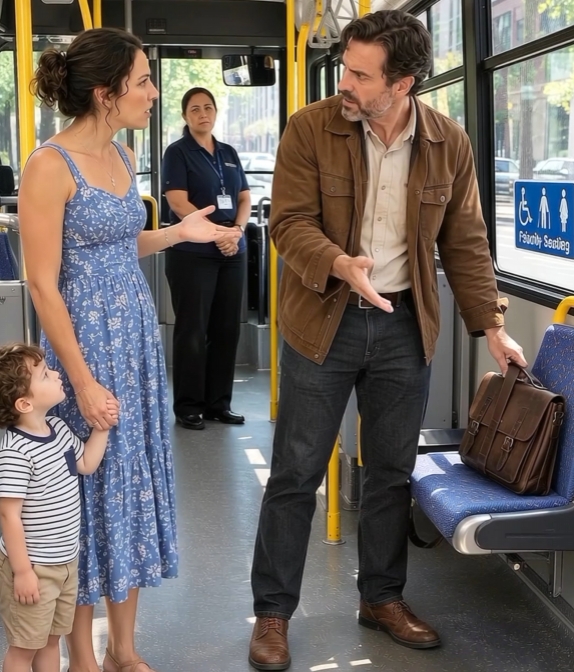
“That seat’s taken.” A man in a brown jacket stands beside a blue bus seat occupied by a leather bag. A woman in a blue dress has a small child by the hand. “My child needs to sit down,” she says, pointing to the seat.
“Don’t touch my property.”
“Then don’t block a public seat.” The man handles the bag’s strap as a uniformed woman approaches down the aisle. “What’s going on back there?” she asks. “She’s demanding my place,” he says. The answer is brief. “That is priority seating.” The child is still standing when the clip ends.
Continuation:
The man picked up the bag. Something inside made a small, terrible crunch. For an instant he shut his eyes. The little boy heard it too.
“Was it your lunch?”
“Worse,” the man said. He opened the flap. Inside was a cardboard box containing what had been a rather beautiful model railway station. The clock tower now lay across the roof. Two tiny passengers had fallen face first onto the platform.
The boy’s mother helped him onto the seat. “Is that why you wanted the space?”
“It’s for my father. He spent thirty years selling tickets in that building. The real one came down last week.” He looked at the child, whose shoes barely reached the front edge of the cushion. “I could have told you that without being rude. Sorry, both of you.”
The boy considered the damage with the seriousness that four-year-olds reserve for other people’s toys. “Your people are tired,” he concluded.
That got a laugh out of the man. He sat across the aisle when another passenger got off, resting the box on his knees. The mother found a clean envelope in her handbag. Folded twice, it made a little shelter for the loose pieces. At each stop, the boy checked that nothing else had fallen over.
They discovered they were getting off at the same place. The man’s father lived above the library. The boy and his mum were going downstairs to return a spectacularly overdue book about whales. As the doors opened, the boy asked for one last look at the station. He pointed at the blank square on the platform wall.
“Where does it say when the train comes?”
The man had spent six months getting every window right and somehow forgotten the timetable his father had stood under every working day.
That evening, father and son sat with the model between them. The broken tower was an easy repair. The timetable took longer. His father insisted the last train on Sundays left at 9:12, then went digging through a drawer until he found the folded yellow sheet to prove it.
He was right. He also remembered who had habitually missed it, who’d sold the best tea, and which bench caught the afternoon sun. By midnight the glue was where they’d left it, unopened. The next morning the man wrote a tiny 9:12 in the timetable square. He left the two passengers sitting together, waiting for their train.