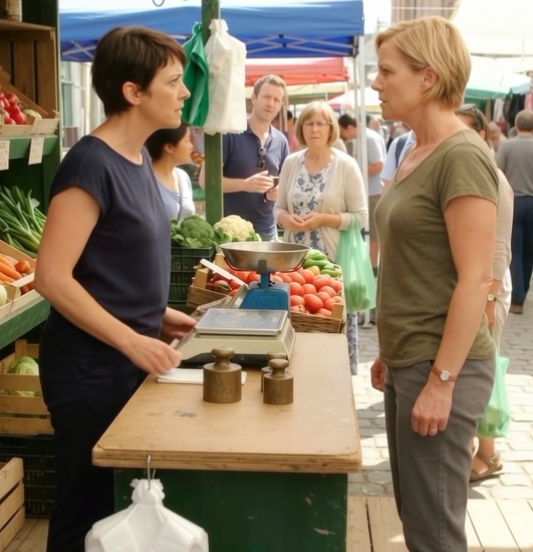
What happens in the video
“Hands off my weights!” At an outdoor produce stall, two women face each other across a counter. In front of them are a scale and two metal weights. “Put them on together,” one woman says.
“They’re both stamped one pound.” The other woman explains what caught her attention. “That one sounded empty when it hit the tray.” They look down at the scale and handle the weights. Then comes the decision: “Let’s do every bag again.” One woman lifts the weighing pan as the clip ends. The footage leaves open how the weights came to sound different.
Continuation:
The first bag was short by two apricots. So was the second. By the time they opened the third, the stallholder, Rosa, had stopped hoping the difference was a fluke.
She set the suspect weight aside and checked the scale with a standard weight borrowed from the market office. The scale balanced. The old metal weight came up light.
Rosa looked down the market aisle. She’d sold nine bags that morning. Three customers were still in sight. She filled a paper sack with apricots and caught the first woman at the flower stall.
“I weighed these wrong,” she said, adding two apricots to the woman’s bag. “You paid for a pound.”
The customer held the bag out obligingly. “Good. I ate two on the way here.”
The other woman, Mae, stayed at the counter and reweighed the stock. She had grown up helping her uncle close a market stall. At the end of every day he dropped the weights into their wooden slots. Even from the back of the van she could tell when the last one went in. That was why the odd sound had caught her ear.
After they finished, Rosa turned the faulty weight over. A faint line circled its base. She took it to her father that evening. He rolled it in his palm and laughed in recognition.
“Where did you find my stamp holder?”
Years ago he’d hollowed out a damaged weight and fitted a little lid so he could keep postage stamps dry under the stall. When Rosa cleared his shed, she’d brought it back with the weighing equipment. He worked the base loose with his thumb. Inside was a single stamp, still folded in waxed paper.
The next market day Rosa put a note at the till offering to make up any short bag from the previous Saturday. Four people came back. A fifth stopped to tell her that if she was giving away apricots he’d be happy to become a customer retroactively.
Mae came by near closing time. Rosa handed her the hollow weight. Inside was a strip of stamps and a note from her father thanking the woman who’d recognized his handiwork by ear.
Mae dropped it gently into her palm and listened. Then she bought a pound of apricots. Rosa added one extra.
“For catching it,” she said.
Mae bit into it on her way to the flower stall. By the time she got there, she rather wished she’d asked for two.