The morning after our mother’s funeral, my brother changed the locks on her house.
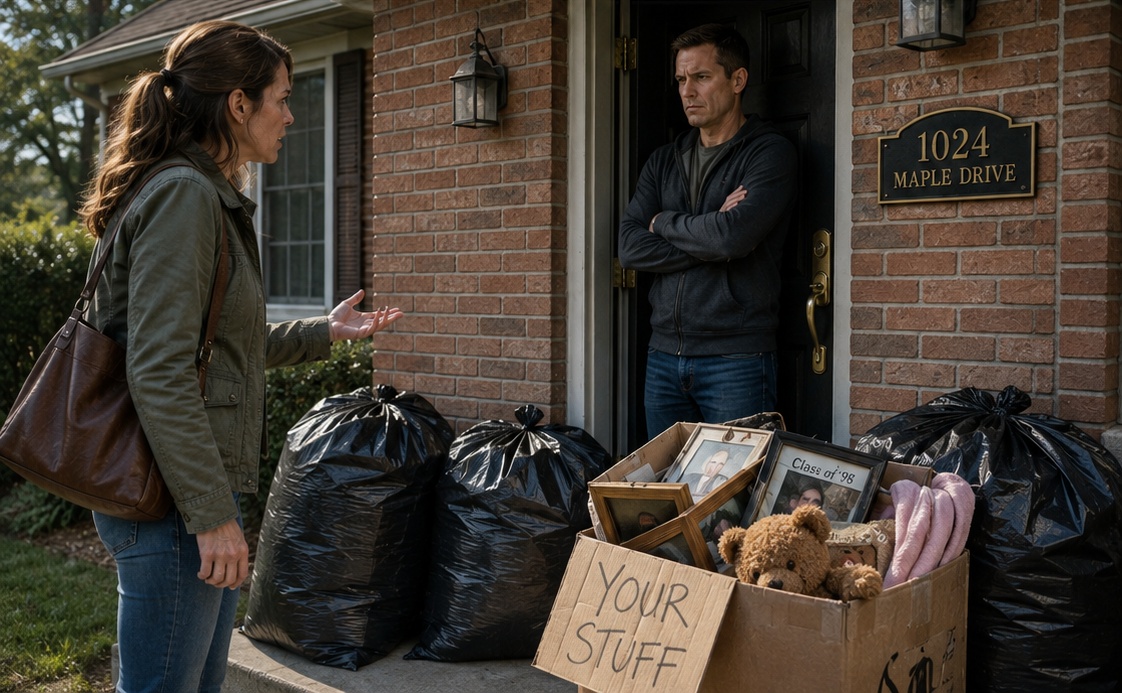
When I arrived to collect the photo albums Mom had promised me, Kevin stood behind the new locked door and smiled.
“You don’t live here anymore.”
I reminded him that the estate hadn’t even been settled.
He laughed.
“Mom left me the house. Accept it.”
Then he placed my childhood belongings into garbage bags and left them beside the driveway.
I didn’t argue.
I simply reached into my purse and touched the sealed envelope Mom had given me two weeks before she died.
Across the front, in her handwriting, were six words:
OPEN THIS IF KEVIN TAKES THE HOUSE.
Until that morning, I’d been too afraid to open it.
My name is Rachel Morgan.
Kevin is my older brother by three years.
Growing up, he was always Mom’s difficult child.
Not bad.
Just complicated.
He changed jobs constantly.
Borrowed money.
Started businesses that disappeared within months.
Whenever something went wrong, Mom rescued him.
I was the opposite.
I moved out at twenty-two.
Built my own career.
Paid my own bills.
For years, I thought Mom helped Kevin more because he needed her more.
Then she became ill.
Suddenly Kevin became incredibly attentive.
He visited almost every day.
He bought groceries.
He drove Mom to appointments.
At first, I was grateful.
I lived forty minutes away and had two teenagers at home.
Having Kevin nearby seemed like a blessing.
Then Mom started saying strange things.
“Kevin keeps asking about the house.”
Another time:
“He brought papers for me to sign.”
“What papers?”
“I don’t know. He said insurance.”
I became concerned.
“Don’t sign anything you don’t understand.”
Mom nodded.
Two weeks before she died, I visited her alone.
She looked exhausted.
Before I left, she called me back.
“Rachel.”
“Yes?”
She pulled an envelope from beneath her pillow.
“Take this.”
“What is it?”
“Don’t open it unless Kevin tries to take the house.”
I almost laughed.
“Mom—”
“Promise me.”
Something in her expression stopped me.
“I promise.”
She died fourteen days later.
The funeral was on Monday.
Tuesday morning, Kevin changed the locks.
I arrived around noon.
My key didn’t work.
I knocked.
Kevin opened the door but kept the chain attached.
“What are you doing?”
“Protecting my property.”
“Your property?”
“Mom left me the house.”
“We haven’t even met with her attorney.”
“I know what the will says.”
That bothered me.
“How?”
Kevin smiled.
“Because Mom told me.”
Then I noticed black garbage bags beside the garage.
“What are those?”
“Your stuff.”
Inside were childhood photographs, school yearbooks, several Christmas ornaments and boxes Mom had saved for decades.
“You put my things in garbage bags?”
“You don’t need to make this dramatic.”
I stared at him.
Then I remembered the envelope.
I drove home.
Sat at my kitchen table.
And opened it.
Inside were three things.
A handwritten letter.
A business card.
And a small flash drive.
The letter began:
Rachel,
If you’re reading this, Kevin did exactly what I was afraid he would do.
My hands started shaking.
Mom explained that several months earlier, Kevin had convinced her to sign documents he claimed were related to property taxes.
Later, she became suspicious.
She contacted an attorney without telling him.
The business card belonged to that attorney.
Mom had discovered that one document appeared to transfer ownership of the house into a trust Kevin controlled.
She insisted she had never knowingly agreed to give him the house.
Her attorney had begun taking steps to challenge the documents.
Then came the flash drive.
Mom had recorded several conversations with Kevin after becoming suspicious.
I called the attorney immediately.
Her name was Susan Feldman.
When I told her who I was, she said:
“I’ve been waiting for your call.”
The following afternoon, we met.
Susan already had copies of Mom’s medical records, the disputed documents and notes from several meetings.
Then she played one of the recordings.
Kevin’s voice filled the room.
“It’s just paperwork, Mom.”
“What does it do?”
“It makes things easier when you’re gone.”
“Does Rachel know?”
“She doesn’t need to.”
Then Mom asked:
“Am I giving you my house?”
There was a long pause.
Kevin answered:
“No. Nothing like that.”
But the document he’d asked her to sign did exactly that.
I felt physically sick.
Susan explained that Mom had signed a new will shortly afterward.
This one had been prepared independently.
The house wasn’t left entirely to me.
Mom wanted fairness.
The estate was to be divided equally between Kevin and me.
But any transfers Kevin had obtained through misrepresentation were to be challenged.
Kevin didn’t know that.
For several weeks, he continued acting as though the house belonged solely to him.
Then his attorney received the challenge.
Kevin called me seventeen times that day.
I didn’t answer.
Eventually, the dispute went to court.
I won’t pretend it was quick.
It wasn’t.
There were handwriting experts.
Medical records.
Witnesses.
Documents.
And Mom’s recordings.
Kevin argued that Mom knew exactly what she’d signed.
The recordings suggested otherwise.
Eventually, the disputed transfer was invalidated.
Mom’s valid estate plan controlled what happened next.
The house was sold.
After expenses, the remaining proceeds were divided according to her will.
Kevin and I each received our share.
People sometimes ask whether I wish Mom had simply left the house to me.
No.
That wasn’t what she wanted.
She wanted both of her children treated fairly.
Even Kevin.
What she refused to accept was one child secretly taking from the other.
Kevin and I didn’t speak for nearly two years.
Then last Christmas, a package arrived.
Inside was one of Mom’s ornaments.
The little wooden angel she’d hung on the tree every December since we were children.
There was a note from Kevin.
This should have been in your box. I’m sorry.
That was all.
I haven’t completely forgiven him.
Maybe someday I will.
But I put the angel on my Christmas tree.
Not because Kevin returned it.
Because it reminded me of Mom.
She spent her life trying to protect both her children.
And in the final weeks of her life, when she realized she might not be there to protect me herself, she left behind something stronger than an argument.
She left the truth in an envelope.
And she trusted me to open it when the time came.