Three days after our father’s funeral, my sister walked into his house with a real-estate agent.
“We’re selling immediately,” she announced.
I thought she was joking.
I’d lived with Dad for the final four years of his life.
I’d cooked for him.
Driven him to appointments.
And spent countless nights sleeping in a chair beside him when he needed help.
My sister, Vanessa, had visited him four times.
But now she wanted half of everything.
At the reading of Dad’s will, Vanessa smiled at me and whispered:
“Don’t expect sympathy to get you the house.”
The attorney opened Dad’s file.
Then he surprised both of us.
“Before we discuss the property, your father asked me to play something.”
He placed a small recorder on the desk.
When Dad’s voice filled the room, Vanessa stopped smiling.
My name is Laura Mitchell.
My father, Henry, was seventy-eight when he died.
He wasn’t wealthy.
He’d worked as an electrician for almost forty years.
But he owned one valuable thing outright.
His house.
A modest three-bedroom home outside Columbus, Ohio.
It was the house where Vanessa and I grew up.
After Mom died, Dad lived there alone for several years.
Then his health began declining.
I moved back in.
At first, I thought it would be temporary.
It became four years.
Vanessa lived two states away.
She always had reasons she couldn’t visit.
Work.
Vacations.
Her husband’s schedule.
The children’s activities.
I never resented her for having a life.
What hurt was how rarely she called Dad.
He noticed.
He pretended he didn’t.
Whenever his birthday came, he’d leave his phone beside him all day.
“Vanessa will probably call after dinner.”
Sometimes she did.
Sometimes she didn’t.
When Dad died, Vanessa arrived the following morning.
She cried at the funeral.
She hugged relatives.
She posted a long tribute online about losing “the greatest father a daughter could ask for.”
Three days later, she brought a real-estate agent to the house.
“What is she doing here?” I asked.
Vanessa looked confused.
“Looking at the property.”
“Dad was buried three days ago.”
“And?”
I couldn’t believe her.
“We haven’t even read the will.”
Vanessa shrugged.
“We both know how this works. Fifty-fifty.”
The agent looked deeply uncomfortable.
I asked her to leave.
Vanessa exploded.
“You don’t own this place, Laura.”
“Neither do you.”
“You’ve lived here rent-free for four years. If anything, you’ve already gotten your share.”
That sentence told me everything.
She had no idea what those four years had actually been like.
Dad’s attorney scheduled the reading of the will for the following week.
Vanessa arrived wearing an expensive suit.
She brought her husband, Mark.
Before the attorney entered, she leaned toward me.
“Don’t expect sympathy to get you the house.”
I didn’t answer.
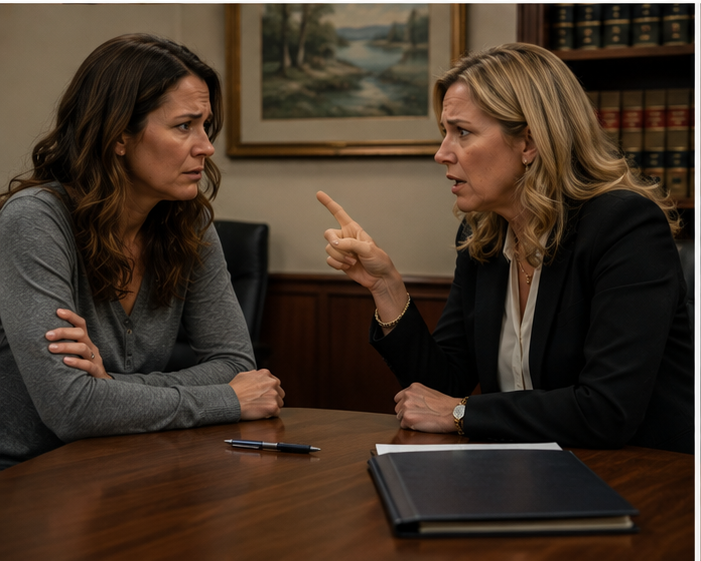
Our father’s attorney, Thomas Greene, entered carrying a thick folder.
He sat down.
“Henry updated his estate plan approximately eight months ago.”
Vanessa immediately frowned.
“Updated?”
“Yes.”
“Why?”
Thomas looked at her.
“He explained his reasoning in his own words.”
Then he removed a small digital recorder.
My heart started pounding.
Thomas pressed play.
Dad’s voice filled the office.
“Laura and Vanessa, if you’re hearing this, I’m probably gone.”
I covered my mouth.
I hadn’t heard Dad’s voice since the hospital.
He continued.
“I love both my daughters. Nothing in this will changes that.”
Vanessa crossed her arms.
“But love and responsibility aren’t the same thing.”
Vanessa’s face changed.
Dad described the previous four years.
He talked about my moving home.
The appointments.
The meals.
The nights I’d missed work.
Then he spoke about Vanessa.
“I kept telling Laura that Vanessa was busy. Truth is, I was embarrassed to admit how much it hurt when she stopped calling.”
Vanessa stared at the recorder.
Dad continued.
Then came the part none of us expected.
“There’s something Vanessa doesn’t know. Laura doesn’t know it either.”
Thomas paused the recording.
He opened the folder.
Dad had refinanced part of the house years earlier to help Vanessa.
I remembered the period.
Vanessa and Mark had nearly lost their business.
Dad told me he’d “helped a little.”
It wasn’t a little.
He’d given them $92,000.
Vanessa had promised to repay him.
She never did.
Thomas produced signed documents acknowledging the loan.
Vanessa’s face went pale.
“That was a gift.”
Thomas shook his head.
“The documentation says otherwise.”
He resumed the recording.
Dad’s voice returned.
“I never wanted the money back if Vanessa couldn’t afford it. But I do want fairness.”
Then Dad explained his decision.
The remaining balance Vanessa owed would be counted against her inheritance.
And the house?
Dad left it to me.
Not because I was his favorite.
His recording made that painfully clear.
He left it to me because it had become my home too.
Vanessa stood.
“This is ridiculous.”
Thomas remained calm.
“The will was properly executed.”
“He wasn’t thinking clearly.”
“Your father underwent an independent capacity assessment before signing it.”
Vanessa looked at me.
“You manipulated him.”
For the first time, I became angry.
“I didn’t even know he’d changed the will.”
She didn’t believe me.
She challenged it.
For months, attorneys exchanged documents.
Medical records were reviewed.
Witnesses were interviewed.
Dad had anticipated nearly everything.
Eventually, Vanessa withdrew her challenge after her attorney warned her how difficult it would be to overturn the estate plan.
I kept the house.
Vanessa received what remained of her portion after Dad’s documented loan was accounted for.
We didn’t speak for almost a year.
Then one afternoon, I received a letter.
Not a text.
A handwritten letter.
Vanessa apologized.
Not for wanting money.
For disappearing while Dad was alive and becoming interested again only after he died.
She admitted she’d been ashamed.
The longer she stayed away, the harder calling him became.
So she kept avoiding it.
I didn’t immediately forgive her.
But I answered.
Today, Vanessa and I speak occasionally.
Our relationship isn’t what it once was.
Maybe it never will be.
But last Father’s Day, she came to the house.
We sat on Dad’s porch.
Neither of us mentioned money.
Eventually, Vanessa looked toward his empty chair.
“I wish I’d called more.”
“I know.”
She started crying.
I reached for her hand.
Dad couldn’t force us to become sisters again.
His will couldn’t repair years of resentment.
But that recording gave us something money never could.
The truth.
And sometimes the truth doesn’t fix a family.
Sometimes it simply gives the people who remain a chance to stop destroying it.