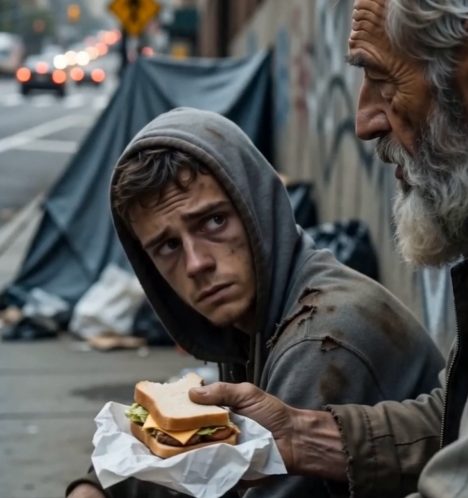
The scene on the sidewalk was grim, a snapshot of urban survival that most commuters filtered out of their vision entirely. The traffic roared past, a blur of indifference, oblivious to the two men huddled against the cold concrete. Mike, eyes cast downward, clutched the sandwich like a lifeline. The older man—who simply went by “Sam”—saw not a beggar, but a boy who had lost his compass.
After the conversation captured in the video ended, the silence between them stretched, but it wasn’t uncomfortable. Sam didn’t offer empty platitudes or tell Mike to “just get a job.” He knew those words were useless to someone drowning in despair. Instead, he told Mike about a time, thirty years prior, when he had sat on a similar patch of concrete, convinced that his life had reached a permanent dead end. He spoke of the day he realized that the city wanted him to disappear, but he refused to let it happen.
Over the next few weeks, Sam became an anchor. He didn’t solve Mike’s problems, but he provided a mirror. He taught Mike where to find clean water, how to secure his belongings, and, more importantly, how to maintain his dignity when society looked right through him. He reminded Mike that a human being’s worth is never tied to an address or a lack of one.
The breakthrough came on a rainy Tuesday. Sam had saved a small amount of money from scavenging scraps, enough to buy a newspaper with job listings and a transit pass. He didn’t give Mike the money; he gave him the paper. “There’s a warehouse two towns over,” Sam said, his voice gravelly but firm. “They need help. Go.”
Mike hesitated, looking down at his worn-out shoes, the weight of his situation threatening to pin him to the ground. But for the first time in months, he saw a path forward. He went. He didn’t get the job on the first attempt, but he learned to speak to people again. He learned to stand tall. A month later, Mike secured a night-shift position at a logistics firm. He used his first paycheck not for himself, but to buy a warm blanket and a hot meal for Sam.
He returned to the spot under the bridge, but Sam wasn’t there. He had moved on, as he always did, drifting like a quiet guardian through the city. But the bridge was no longer Mike’s home. He had found his footing.
The sandwich shared on that sidewalk was never really about hunger. It was about the realization that no one is truly alone as long as there is someone willing to stop, look them in the eye, and ask, “What’s your name?”…