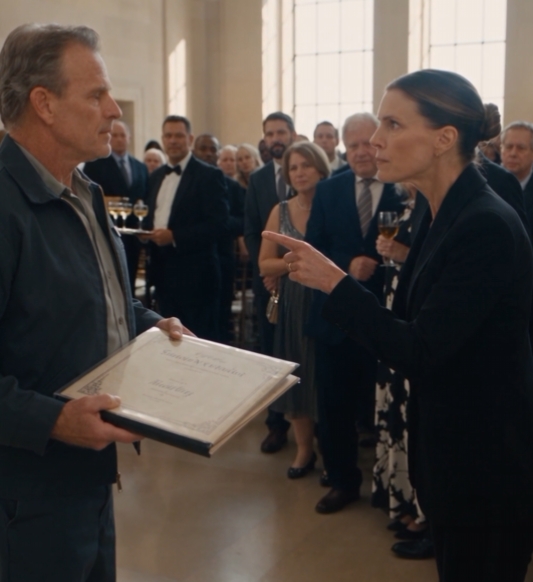
“Deliveries are finished.” A man carrying an open folder faces a woman in black at a formal wedding gathering. “This is for the bride,” he says.
“We did not order it.”
“Her father wrote the music.”
“Take it away!” Guests watch from behind them. A bride approaches and looks toward the folder. The final audible phrase is, “It is the composition.” The pages remain in the man’s hands when the video ends.
The story continues:
The bride recognized the handwriting at the top of the first page. Her father always made his capital letters too large. Even his shopping lists looked as if they were announcing a concert.
“Where did you find it?”
The man introduced himself as Paul, a friend from her father’s old music group. They had been clearing out a rehearsal room when he found the folder between two stands. Inside was a note explaining that the piece was meant for his daughter’s wedding, whenever that day came.
Her father had died before she became engaged.
The bride read the title twice. It was the nickname he’d used when she was small. Suddenly she could hear him calling it up the stairs when dinner was ready.
Paul had brought a copy for the musicians and the original for her. He’d contacted the venue earlier, but the message had been lost among the day’s arrangements. The woman in black looked at the pages and admitted she hadn’t checked.
“I should have asked before sending you away.”
The bride asked whether the musicians had time to look at the piece. They did. While guests were served drinks, Paul sat with them and explained the places where her father’s handwriting became difficult.
The music began just before dinner. At first it sounded unfamiliar. Then a little phrase emerged that the bride recognized from childhood, something her father used to hum while washing dishes.
She reached for her husband’s hand.
The piece was short. When it finished, nobody spoke immediately. Then her aunt laughed through tears and said he’d finally finished a tune instead of stopping halfway through to answer the phone.
That evening the bride took the original pages back to her room. In one margin was a crossed-out instruction. Under it her father had written, Try it slower. Let her hear it.
She had the music recorded later with Paul’s help. On the recording, they left a few seconds of silence before the first note. She liked the sense of somebody getting ready to play.
Years afterwards, their child learned the tune on a small keyboard. The rhythm wandered and one hand lagged behind the other. She sat nearby, resisting the urge to correct every mistake. When the child asked how fast it should go, she opened the old folder and showed the penciled note in the margin.
Together they tried it slower.