The bustling terminal of the airport hummed with the chaotic energy of a major flight delay. Passengers rushed past, their faces combinations of frustration and exhaustion. In the center of the terminal stood a crowded charging station, a rare oasis of power where every single outlet was occupied.
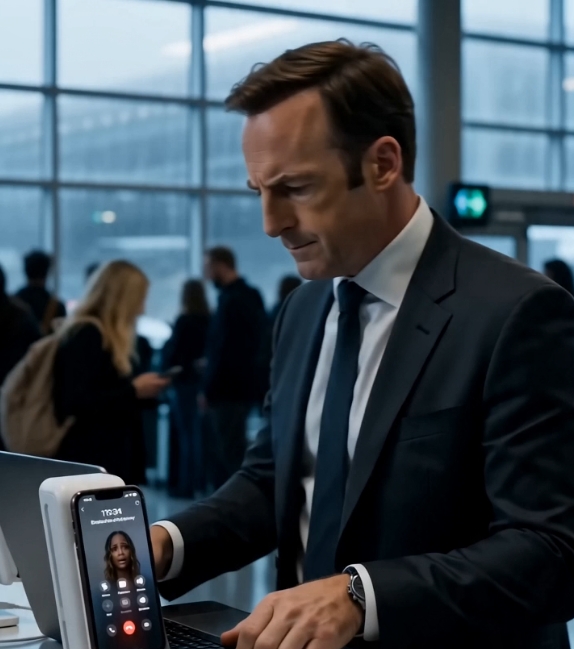
A businessman in a sharp navy blue suit and a crisp white shirt stood over his laptop, typing furiously. His own phone was propped up on a charging stand right beside him, already at a comfortable ninety-six percent capacity. He was completely locked into his work, unbothered by the stress of the delayed travelers around him.
Suddenly, a young woman broke through the crowd, running toward the charging station. She was drenched in sweat and tears, her hair matted against her forehead, her breathing ragged as she struggled with the weight of her green backpack. She stopped right in front of the businessman, desperation written across her face.
“Excuse me,” she gasped, her voice trembling. “Cou ld I borrow that outlet for just five minutes, please? My phone is about to die, and I really need it.”
The businessman didn’t even look up from his screen, his fingers continuing their rapid dance across the keyboard. “I need it too,” he muttered coldly, dismissing her with a slight shake of his head.
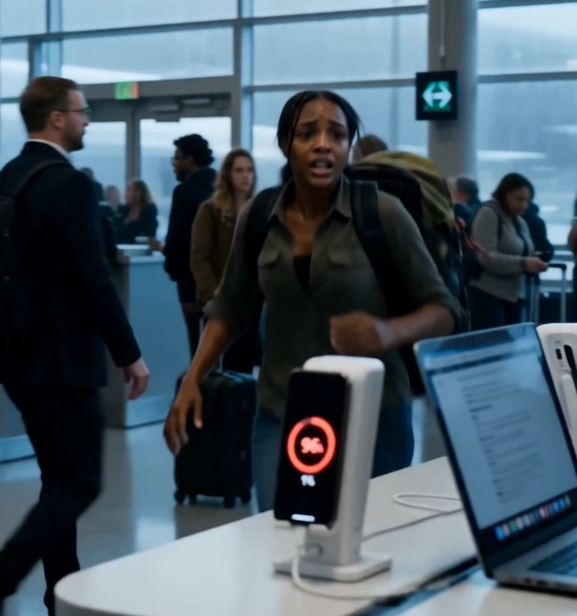
The woman’s face crumpled. She looked down at her phone screen, which was trapped at a critical nine percent. Just then, the phone began to vibrate, and an incoming call screen appeared with a startling label: “Children’s Hospital – Doctor Calling.”
Tears spilled over her cheeks as she held the phone up, showing it to the businessman. “They’re calling about my son,” she sobbed, her voice breaking entirely. “Please… I have to take this.”
The businessman froze. He looked from the flashing screen to the utter panic in the mother’s eyes, and his cold exterior instantly shattered. The urgency of his emails faded to nothing against the gravity of her crisis.
Without saying another word, he quickly reached forward and disconnected his own phone from the charging dock, pulling his wire away to clear the space. He gestured to the open stand, his tone shifting from cold dismissal to quiet empathy.
“Here,” he said softly, stepping back to give her room. “Take it.”
The mother gasped, a wave of profound relief washing over her face as she hurriedly placed her phone onto the charging dock to preserve the dying battery. “Thank you,” she whispered, her eyes shining with gratitude as she answered the call.
The businessman nodded silently, picking up his laptop and giving her the space and privacy she needed, proving that even in the most frantic environments, a moment of human empathy can change everything.
Fortunately, this high-stakes airport drama exists entirely in the digital world. The hyper-realistic sequence is a completely fictional piece of media, masterfully generated using advanced AI video and text tools. This artificial simulation demonstrates how powerful modern technology can be at capturing intense emotional arcs and shifting character dynamics—all without a single real parent having to endure such an agonizing flight delay.