The Folder in Her Hands
Flames rose from a pan as the kitchen staff worked along the stoves.
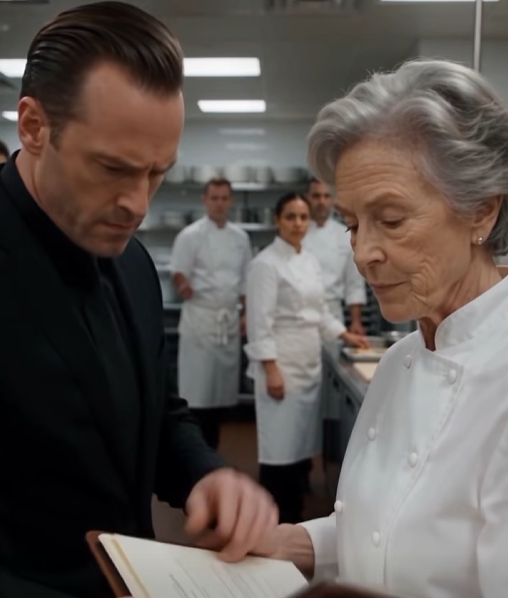
An older woman in a white chef’s jacket walked through the kitchen carrying a brown folder. A male chef dressed in black stepped toward her.
Their exchange became confrontational. He leaned toward her, speaking sharply and gesturing, while she stood her ground. Around them, members of the kitchen staff watched.
The woman opened her folder and presented a document.
He took it and began reading.
His attention shifted from the paper to a silver-haired man in a suit approaching through the kitchen. The suited man joined them and shook the male chef’s hand. The woman remained beside them with the folder open as the conversation continued.
The clip ends without showing whether the male chef apologizes, loses his position, or accepts her authority.
Chef Martin read the document a second time.
Executive Head Chef.
Beneath the title was the woman’s name: Eleanor Hayes.
He looked toward the restaurant owner.
“You’ve hired my replacement without speaking to me?”
“I asked you to meet with me twice last week,” the owner replied. “You canceled both appointments.”
Martin handed the document back.
“Well, congratulations,” he said to Eleanor. “I hope you understand what you’re taking on.”
She returned the page to her folder.
“I understand we have customers waiting.”
For a moment, nobody moved.
Then Eleanor turned toward the stove.
“Who’s handling that sauce?”
A young cook raised his hand.
“Show me where you are.”
Martin gave a short laugh.
“You haven’t been here five minutes, and you’re already interfering.”
Eleanor stopped beside the cook.
“I’d like us to get through service. We can discuss our roles afterward.”
“My role is running this kitchen.”
“Until today,” the owner said.
Martin’s face hardened.
He looked around, perhaps expecting someone to object on his behalf. The staff watched him in uncomfortable silence.
Finally, he pulled off his apron.
“Fine. Let’s see how well they do without me.”
He dropped it on the counter and walked toward the office.
Eleanor waited until the door closed.
Then she looked at the young cook.
“The sauce?”
He held out a spoon.
She tasted it.
“A little more stock. Slowly. You’re nearly there.”
Service was difficult.
Two orders were returned. A supplier arrived late. Eleanor had to ask where the spare pans were three times.
She didn’t pretend to know the kitchen yet.
By the end of the evening, the staff were exhausted, but every table had been served.
Martin emerged from the office while they were cleaning.
He watched Eleanor help lift a heavy pot into the sink.
“Making friends?” he asked.
She set down the pot.
“Finishing.”
The owner came out behind him.
“Martin, we need to speak.”
This time, the conversation happened behind a closed door.
He was told his employment was ending. His refusal to cooperate that evening had settled a decision already under consideration after repeated complaints from the staff.
He wasn’t dismissed simply because a new chef had arrived. He was dismissed because, when given an opportunity to work with her, he chose to undermine her.
Two days later, Martin returned for his knives.
Eleanor brought the case from the office, but he didn’t reach for it.
“I shouldn’t have spoken to you like that.”
“No,” she said. “You shouldn’t.”
He glanced toward the kitchen.
“I was afraid of losing my place here. When you walked in, I took it out on you.”
Eleanor waited.
“And the others,” he added. “I owe them an apology too.”
“They’re here. You can tell them.”
Martin entered the kitchen.
His apology was awkward, but he made no excuses. He acknowledged the shouting, the insults, and the way he had treated questions as challenges to his authority.
Nobody applauded. One cook nodded. Another quietly thanked him.
When he returned, he picked up his knife case.
“I’m sorry it took losing the job to make me listen.”
Eleanor studied him.
“Would you be willing to work as my assistant?”
He looked up sharply.
“You’d let me stay?”
“I’m willing to give you another opportunity. You have experience this kitchen can use. But you’ll need to listen, take direction, and treat people with respect.”
Martin looked down at the case.
For years, he had expected everyone else to accept his instructions. Now someone was asking whether he could do the same.
“Yes,” he said. “I can do that.”
“Then I’ll speak to the owner. If we agree on the arrangement, you can start Monday.”
His eyes filled.
“After what I said to you?”
“I’ve chosen to forgive you, Martin. What you do with this chance is up to you.”
On Monday, he arrived twenty minutes early.
Eleanor handed him an apron and the preparation list.
“Start with the vegetables, please. Then we’ll go through the lunch menu.”
“Yes, Chef.”
Later, a young cook spilled a tray of chopped onions.
Martin turned at the noise. The cook immediately began apologizing.
For a moment, Eleanor watched him.
Then Martin crouched and reached for the dustpan.
“Get another onion,” he told the young man. “I’ll clear this up.”
By lunchtime, Martin had questions about Eleanor’s menu. He waited until she finished speaking, then asked them.
At the end of service, she tasted the sauce he had prepared.
“That’s good, Martin.”
He smiled.
“Thank you, Chef.”
Then he picked up a clean spoon and asked her to show him how she wanted the next one made.