A fictional story about separation, kindness, and finding a way home.
For twenty years, Elias kept a wooden lockbox beneath the register of his roadside diner.
Its corners had darkened with age. A pale ring marked the lid where someone had once rested a coffee cup. Every few months, he wiped away the dust and checked the small brass lock.
He could have asked a locksmith to open it. But he knew what was inside, and opening it without the person who held the key felt like admitting she would never return.
Then, on a rain-soaked Thursday evening, a young woman walked through his door.
Her name was Maya.
She had enough money for neither a meal nor a room, and the one thing she refused to sell was a brass key that had belonged to her mother.
A Meal Before Midnight
Maya stood just inside the entrance while rainwater dripped from the hem of her coat.
Behind the counter, Vince glanced at the clock. The dinner rush had ended, leaving a truck driver by the window and an elderly couple sharing the last slice of apple pie.
“Kitchen closes soon,” he said.
“I won’t take long.”
Maya approached the counter, keeping her hands in her pockets.
“Could I wash some dishes? Or clean the floors? Just for something warm to eat.”
Vince set down his pen.
“We have people for that.”
“Anything would help.”
Before Vince could answer, Julian stepped out from behind the coffee machine.
“Sit wherever you like,” he told her.
Then he took several folded bills from his tip jar and placed them beside the register.
“Soup, bread, and a cup of tea. Put it on my ticket.”
Maya started to protest.
Julian was already reaching for a bowl.
“The soup’s good tonight,” he said.
She chose a stool at the end of the counter, near the old jukebox. When the food arrived, she wrapped both hands around the bowl.
Julian busied himself nearby, giving her the privacy to eat without feeling watched.
Only after the bread was gone did Maya reach into her coat.
“I don’t have money to repay you.”
“You don’t need to.”
“I know. But I want you to have something.”
She placed a heavy brass key on the counter. Its handle curled into a pattern of leaves, worn smooth along one edge.
“My mother kept it for years,” Maya said. “She used to say it opened the only place she’d ever really felt at home.”
Julian looked at the key, then at her.
“That sounds like something you should keep.”
Across the aisle, Elias stopped sorting receipts.
“May I see that?”
The Photograph in the Box
Maya pushed the key toward him.
Elias picked it up carefully. Near its stem was a shallow notch, the mark he had made years earlier while trying to straighten it with a pair of pliers.
“Who was your mother?”
“Nora.”
He rested his free hand on the counter.
“And your name?”
“Maya.”
For a moment, he said nothing.
Then he went behind the register and crouched with more care than usual. When he stood, he held a small wooden box.
Maya watched him set it down.
“My mother had something like that,” she said. “I think. I remember a box in a kitchen.”
Elias offered her the key.
“Would you try it?”
It caught at first. She adjusted it, turned again, and heard the lock release.
Inside lay a bundle of letters, a small knitted mitten, and a photograph.
Maya lifted the photograph by its white border.
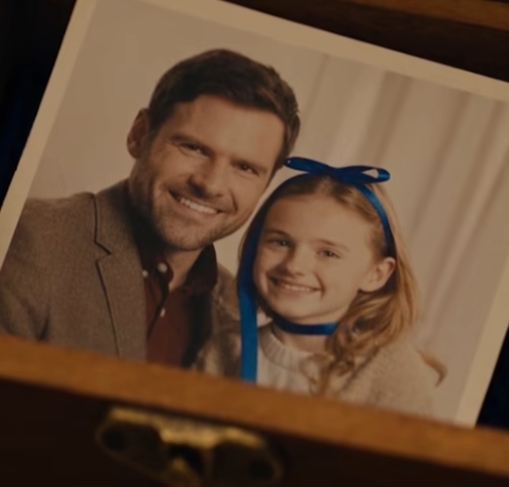
A younger Elias stood outside the diner with a little girl balanced on his hip. Beside them, Nora was laughing at something beyond the camera.
Maya recognized her mother immediately.
Then she noticed the girl’s coat.
Yellow, with one crooked wooden button.
She had worn that coat in another photograph—the only childhood picture she still carried.
“Where did you get this?”
Elias pulled out the stool beside her.
“We took it here. On your third birthday.”
Maya looked from the photograph to his face.
“My father’s name was Elias.”
“Mine is too.”
She lowered the picture onto the counter.
“He knew where we were?”
Elias shook his head.
“No,” he said. “I didn’t.”
The Year Everything Fell Apart
There had been a time when the diner was busy enough that Nora complained they never ate a hot meal together.
She worked the counter. Elias cooked. Maya spent her afternoons in the booth nearest the kitchen with crayons, picture books, and a stuffed rabbit that smelled faintly of pancake syrup.
Then the highway changed.
A new bypass carried traffic away from the diner. Within months, the regular stream of travelers became an occasional trickle.
Elias fell behind on payments. When the refrigerator failed, he borrowed money to replace it. When the roof began leaking, he postponed the repair until water damaged the ceiling.
He kept telling Nora that he could turn things around.
What he rarely told her was how frightened he had become.
Nora offered to move closer to her sister and find work. They could stay with her for a few months, she said. Catch their breath. Decide what to do next.
Elias heard those suggestions as surrender.
Nora heard his refusals as proof that the diner mattered more than she did.
One evening, after another argument over unopened bills, she asked him a question.
“If this place costs us everything, will you still think keeping it was worth it?”
He was exhausted and ashamed.
He answered too quickly.
“I can’t walk away.”
Nora waited for him to say more.
He didn’t.
By morning, she had packed a suitcase.
On the kitchen table, she left a note saying she was taking Maya to her sister’s. She needed time, and she wanted him to understand that something had to change.
She took the brass key without thinking. It had been on her key ring since the day they bought the lockbox together.
At first, neither of them believed the separation would last.
The Silence That Grew
Elias wrote to Nora at her sister’s address.
His first letters were full of explanations: the bills he had paid, the extra hours he was working, the customer who thought business might improve in spring.
He struggled to write the one thing she needed to hear—that he understood why she had left.
Nora answered once.
She said Maya was well. She had found temporary work. She needed him to listen before asking her to come back.
They spoke by telephone several times, but each conversation returned to the same hurt.
Then Nora’s sister moved. Nora found a small apartment elsewhere, and a letter containing the new address never reached Elias.
By the time he realized the address he had was no longer current, they had lost the few practical connections that might have brought them back together.
He contacted people they had known. He asked for help finding her. He returned to the last address he had and found another family living there.
Nora, meanwhile, waited for an answer that never arrived.
Pride made the first months harder. Shame made the next ones harder still.
Eventually, Maya stopped asking when they would go home.
As she grew older, Nora told her only that her parents had loved each other once and had been unable to make their life together work.
“She never said you were cruel,” Maya told Elias. “She just got quiet when I asked about you.”
Elias looked at the open box.
“I wish I’d tried differently,” he said. “I thought working harder would fix things. Even after she left, I kept thinking I had to save the diner before I could bring you home.”
Maya ran her thumb along the edge of the photograph.
“Did you?”
“Save it?”
She nodded.
“Eventually.”
He looked around the quiet room.
“It took a long time to understand what that hadn’t fixed.”
What Nora Left Behind
Nora died two years before Maya entered the diner.
Among her belongings, Maya found the brass key in a cloth pouch, alongside the photograph of herself in the yellow coat.
There was no address.
There was only the name of a town written faintly on the back of the picture.
For a while, Maya kept both objects in a drawer. She was grieving, working, trying to keep up with rent. Searching for a father she barely remembered felt like something meant for another life.
Then the shop where she worked closed.
Unable to afford her apartment, she packed what she could carry and took a temporary job several towns away. When that ended, she found another.
Eventually, her travels brought her near the town written on the photograph.
She bought a bus ticket.
At the local library, an old directory gave her the diner’s address, though she didn’t know whether Elias still owned it—or whether he was even alive.
She had intended to ask about him.
But by the time she arrived, she was soaked, hungry, and frightened of the answer.
“So you came looking for me?” Elias asked.
“I came looking for someone who might remember you.”
“And you were going to give the key away?”
Maya looked at Julian.
“He helped me before he knew anything about me.”
Julian shook his head gently.
“You still weren’t leaving without it.”
A Place to Stay
They talked until the diner closed.
Julian turned the sign in the window and made another pot of tea. Vince finished his paperwork in silence.
There were questions Maya wasn’t ready to ask, and others Elias couldn’t answer neatly.
She wanted to know why no relative had found her. He wanted to hear about every year he had missed. Sometimes their memories overlapped; more often, they revealed how little each had known.
When Elias finally mentioned the apartment above the diner, he chose his words carefully.
“There’s a spare room,” he said. “It’s mostly boxes right now. But it’s warm, and the door locks.”
Maya glanced toward the stairs.
“You can stay tonight,” he added. “After that, we’ll work out whatever you’re comfortable with.”
She nodded.
“Tonight would help.”
While Elias found clean bedding, Julian carried up her bag.
It was lighter than either man expected.
Learning Each Other
Maya did not begin calling Elias “Dad” the next morning.
For several weeks, she called him by his name.
He learned to accept that without looking disappointed.
She helped in the diner while applying for work nearby. Elias paid her for every shift and wrote the hours down where she could check them.
Some evenings they talked about Nora.
Other evenings they discussed nothing more difficult than the leaking upstairs tap or the price of coffee beans.
Their first serious disagreement was over a delivery order. Elias corrected Maya in front of a customer, and she went quiet for the rest of the afternoon.
Later, he knocked on her door.
“I could have handled that better.”
“Yes,” she said.
He waited.
Then she opened the door wider.
It was a small exchange, but one that mattered. This time, neither of them let an awkward conversation become a lasting silence.
Elias also spoke to Vince.
He made clear that turning away someone asking for food with contempt was unacceptable. When Vince dismissed the concern and complained about Maya receiving special treatment, Elias ended his employment.
Julian accepted the manager’s position a month later.
His first suggestion was a simple one: set aside a few meals each day for people who needed them.
Elias agreed.
Nora’s Kitchen
By spring, Maya had found steady work in town and saved enough to choose whether to stay.
She stayed.
On weekends, she helped Elias repaint the diner. Together, they repaired the booths, replaced the cracked window by the entrance, and sorted through cupboards that hadn’t been emptied in years.
In one drawer, Maya found a recipe card in her mother’s handwriting.
Apple cake. Cinnamon. A note at the bottom reminding Elias not to open the oven too early.
Maya laughed when she read it.
“She used to tell me the same thing.”
They made the cake that afternoon.
The first one sank in the middle.
Elias insisted the oven ran cold. Maya pointed at the open oven door.
For the first time, they laughed about Nora without either of them having to stop.
A few weeks later, they ordered a new sign.
Nora’s Kitchen
Beneath it, in smaller letters:
Meals, coffee, and a warm welcome.
The wooden lockbox stayed behind the register, but Elias no longer kept it hidden.
Inside were the old letters, the little mitten, and two photographs.
In the first, he held Maya on her third birthday.
In the second, they stood outside the freshly painted diner with Julian, squinting into the afternoon sun.
Maya kept the brass key.
It hung beside the key to the upstairs apartment and the one to the diner’s front door.
Most nights, Elias still asked whether she had eaten.
Most nights, she reminded him that they had just worked the same dinner shift.
But she answered anyway.
And when she went upstairs, she called goodnight from the landing, knowing he would be there to hear her.