He walked past her every day, until a familiar melody changed his life forever.
The city does not pause for anyone. It is a machine of steel, glass, and relentless momentum, fueled by the ticking clocks of people who have forgotten how to breathe. Julian was a man who lived by that clock. His life was a series of scheduled appointments, high-stakes meetings, and the polished veneer of corporate success.
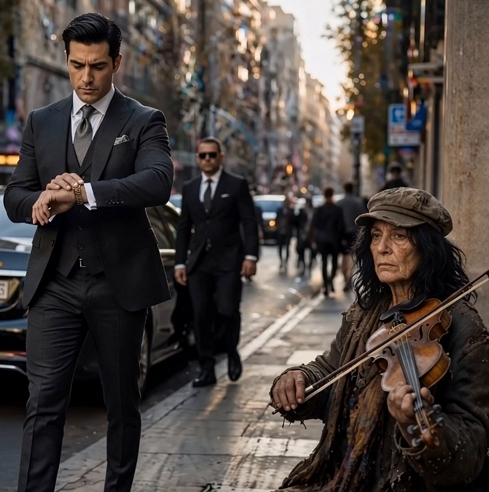
Every morning, he walked the same path, his gaze fixed on the pavement or his glowing smartphone. To Julian, the city was a backdrop to his own ambitions. It was a space to be conquered, navigated, and utilized. He paid little mind to the people who inhabited the fringes of his route—until the morning the music stopped him.
The Sound of Disruption
On a crisp Tuesday, the sidewalk was unusually congested. A street musician—an elderly woman in worn, threadbare clothing—had set up her spot near the corner of the financial district. She sat on the cold stone, her violin tucked under her chin, coaxing a melody from the instrument that seemed far too elegant for such a gritty environment.
Julian, checking his watch with practiced irritation, was forced to slow his pace. The music was piercing, rising above the low-level roar of idling car engines and impatient commuters.
“Not today,” he muttered, brushing past her, his tone clipped with the arrogance of someone who felt his time was more valuable than art. “Stop that noise.”
He didn’t stop to see the look in the woman’s eyes—a flicker of fatigue, a lifetime of stories etched into the lines of her face. He just wanted the silence back so he could return to the comfort of his own schedule.
The Bridge to Yesterday
But the music didn’t stop. As he walked away, a specific, haunting chord hung in the air, vibrating against the buildings. It was a sequence of notes so precise, so intimate, that it bypassed Julian’s logical mind and struck directly at his core.
In an instant, the city vanished. The grey asphalt of the financial district was replaced by the warm, amber glow of a bedroom he hadn’t seen in thirty years.
He was a boy again, tucked under a heavy duvet, feverish and restless. He could feel the weight of his mother’s presence, the smell of lavender tea, and the soft, steady rhythm of her breathing. He saw her sitting at the edge of his bed, just as she did every time he was sick, holding a violin—the very same instrument his father had given her. She played, not for an audience, but for him, to ease his mind and soothe his soul.
The melody on the sidewalk was the exact lullaby his mother had played to him in that room. It was the sound of safety. It was the sound of unconditional love.
A Transformation in Real Time
Julian stood paralyzed in the middle of the crowded street. The people rushing past him were now just blurred shapes in the periphery. His heart, usually kept at a regulated, professional tempo, began to race. He realized with a sudden, devastating clarity that the noise he had labeled “annoying” was, in fact, a miracle.
He turned back.
As he walked toward the woman, his stride was no longer hurried. He stopped directly in front of her. She looked up, bracing herself for another reprimand or a gesture of dismissal. Instead, she found a man whose eyes were glassy with unshed tears.
He didn’t just drop money into her case; he knelt on the cold stone beside her, indifferent to the pristine quality of his tailored suit. He listened to the rest of the song, his expression shifting from corporate hardness to genuine vulnerability. When she played the final note, the street felt quiet—not empty, but peaceful.
Julian reached out, not with the transaction of a stranger, but with the familiarity of a son. He pulled the woman into an embrace. It was an embrace that transcended her social status and his wealth. In that moment, they were not a businessman and a street musician; they were two souls connected by the universal language of memory and the resilience of the human spirit.
The Lesson of the Sidewalk
He left her with more than just a donation. He left her with the validation that her art mattered, that she had been heard, and that she was not invisible.
When Julian returned to his office that day, his watch remained in his pocket. He had learned the most important lesson of his career: the true value of a life is not measured by how well we manage our time, but by how well we use it to connect with those around us.
We are all carrying memories—lullabies, stories, and moments of love—that define who we are. Sometimes, it takes a single song, played on a busy street corner, to remind us that we are all walking the same path, and that a little bit of kindness is the only melody that truly matters.