I married a stranger from a hospital waiting room so he wouldn’t die alone.
One week later, his lawyer handed me a heavy green backpack and said:
“Julian wanted you to know the truth. He knew who you were before you ever entered his room.”
Part 1: The Man by the Window
I was twenty-nine and still struggling with the loss of my mother.
She had died eleven months earlier after a long illness.
During her final weeks, I spent every night beside her hospital bed. I read her favorite stories, brushed her hair and held her hand whenever she became frightened.
After she died, I couldn’t bring myself to leave the hospital behind.
I started volunteering in a companionship program for terminally ill patients who had no relatives nearby.
The work was painful, but it gave my grief somewhere useful to go.
That was how I met Julian Vale.
He was seventy-two and dying from heart failure.
Every afternoon, he sat beside the window in Room 408, watching people cross the hospital courtyard.
Unlike most patients, Julian never watched television.
He had no flowers, cards or family photographs.
Only an old green backpack rested beneath his bed.
“Do you have anyone you’d like us to contact?” I asked during our first conversation.
Julian shook his head.
“Not anymore.”
Despite his illness, he possessed a gentle sense of humor.
He told terrible jokes, complained about the hospital coffee and insisted that the squeaking wheel on his medication cart was secretly communicating with him.
Within days, our conversations became the best part of my afternoons.
Then, one evening, Julian reached for my hand.
“Marry me, Nora.”
I thought I had misunderstood him.
“Julian, we’ve known each other for four days.”
“I know.”
“You’re seriously ill.”
“I know that too.”
He looked toward the empty chair beside his bed.
“I’ve spent most of my life being afraid of depending on anyone. I don’t want fear to be the final thing I feel.”
I told him that marriage was more than a comforting gesture.
“Then let it mean this,” he replied. “For whatever time remains, neither of us has to be alone.”
His doctors confirmed that he understood exactly what he was requesting.
Two days later, a hospital chaplain married us in the small interfaith room downstairs.
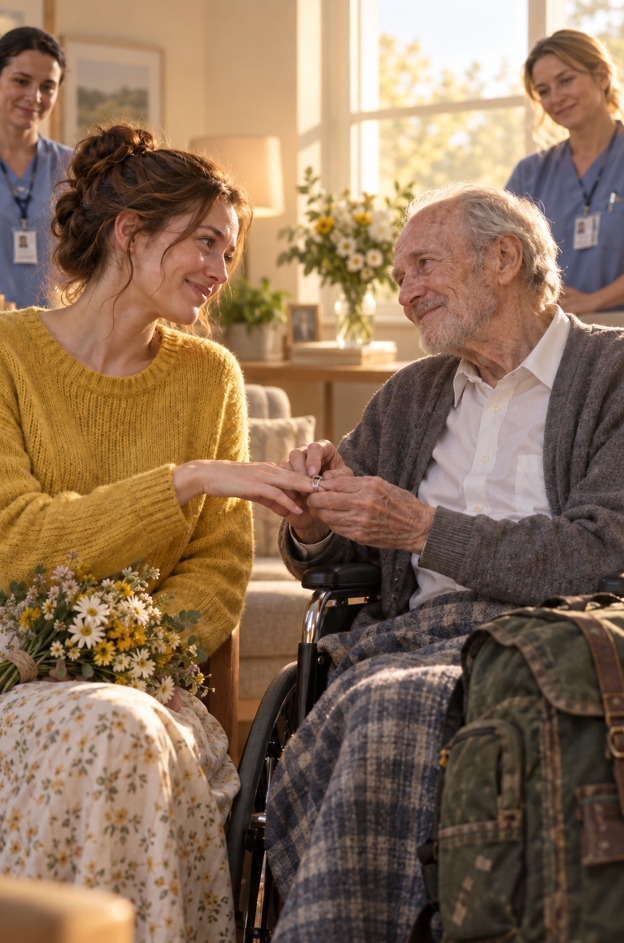
I wore a yellow sweater because it had been my mother’s favorite color.
Julian wore a clean white shirt that a nurse found in the donation cupboard.
We had no wedding rings.
Smiling weakly, Julian slipped the pull tab from a soda can onto my finger.
“I promise to upgrade it if I recover,” he said.
Everyone laughed.
Part 2: Our Seven-Day Marriage
Julian and I were married for one week.
During those seven days, I read to him, played old jazz records and listened to stories about the repair shop he had once owned.
He said he had spent decades fixing radios, cameras and clocks.
“Broken things rarely need to be thrown away,” he told me. “Most of them are simply waiting for someone patient enough to understand them.”
On our final night, his breathing became shallow.
I sat beside him and held his hand.
“Nora,” he whispered, “when the truth comes, please don’t be angry.”
I leaned closer.
“What truth?”
But Julian was too weak to answer.
He died shortly before dawn with my hand wrapped around his.
Afterward, I remained in the empty room, staring at the silver pull tab on my finger.
A short marriage should not have left such a large silence.
An hour later, an elderly man in a gray suit entered the room.
He carried Julian’s green backpack.
“Are you Nora Bennett?”
I stood slowly.
“Yes.”
“My name is Arthur Bell. I was Julian’s attorney.”
He placed the backpack in my hands.
It was much heavier than I expected.
Arthur watched me carefully.
Then he lowered his voice.
“Julian wasn’t who you thought he was. He wanted you to know the truth.”
Part 3: My Mother’s Photograph
The first thing inside the backpack was an old camera.
Beneath it were dozens of photographs bound together with a blue ribbon.
I untied them.
The first image showed Julian as a much younger man standing outside a small repair shop.
The next showed a community picnic.
Then I reached the third photograph.
My hands went numb.
The woman in the picture was my mother.
She was young, perhaps twenty-five, and she stood beside Julian while holding a little girl.
Me.
I turned toward Arthur.
“How did he have this?”
Arthur handed me a sealed letter.
My name was written across the front.
I opened it with shaking hands.
Dear Nora,
I recognized you the first afternoon you entered my room. You have your mother’s eyes and the same small scar above your eyebrow.
You were three years old when I last saw you.
There is something your mother never told you because she believed kindness should not create a debt.
The letter explained that Julian’s repair shop had burned down twenty-six years earlier.
He had lost everything.
While standing outside the ruins, he suffered a heart attack.
My mother, who was passing by with me in a stroller, called for help and performed CPR until the ambulance arrived.
She saved his life.
During Julian’s recovery, she organized a neighborhood fundraiser that allowed him to reopen his shop.
For years afterward, Julian and my mother remained friends.
Then they lost contact when she moved away.
Julian had spent years trying to find her.
He discovered her address only after reading her obituary.
“He came to her funeral,” Arthur explained. “He remained at the back because he believed introducing himself that day would add to your pain.”
I looked down at Julian’s letter.
When you entered my hospital room, I thought your mother had sent you to return the kindness I never properly repaid.
I should have told you immediately. But for one selfish week, I wanted you to know me as Julian—not as a debt your mother left behind.
Tears blurred the final lines.
You did not marry a stranger, Nora.
You married an old friend of your mother who had been given twenty-six extra years because she refused to walk past a person in need.
Part 4: The Key at the Bottom
At the bottom of the backpack was a small brass key.
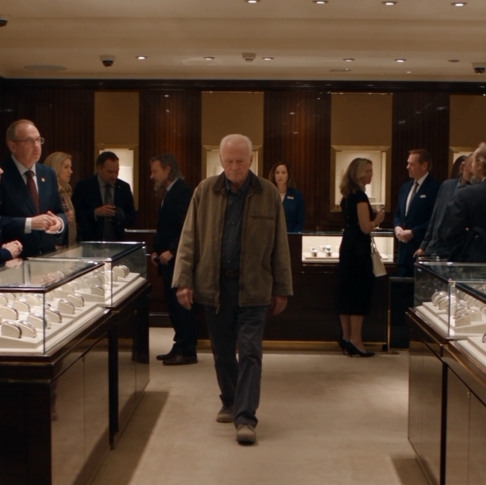
It opened Julian’s former repair shop.
The building had been closed for almost ten years, but he had never sold it.
When Arthur and I entered, dust covered every surface.
Clocks lined the walls. Old cameras filled the shelves. Boxes of photographs sat beneath the counter.
On the back wall hung a framed picture of my mother.
Beneath it, Julian had written:
For Claire, who taught me that a stranger’s life is still worth saving.
Arthur explained that Julian had left the building to me.
He had also created a modest trust to restore it.
There was one condition.
I had to use the property for something that helped people feel less alone.
I didn’t know whether to laugh or cry.
“He planned all of this before asking me to marry him?”
Arthur shook his head.
“The building was already yours. The marriage changed nothing about the will.”
That answer mattered more than I expected.
Julian had not married me to transfer property or avoid a legal problem.
He had simply wanted someone beside him.
Part 5: Restoring the Shop
For several months, I spent every weekend repairing the building.
Hospital volunteers helped repaint the walls.
Former customers donated tools and furniture.
One retired carpenter rebuilt the damaged front counter.
While clearing an upstairs room, I found hundreds of portraits Julian had taken throughout his life.
They showed ordinary people in moments that usually went unnoticed—a mechanic washing grease from his hands, a child comforting her younger brother and a nurse asleep beside a patient’s bed.
Julian had been more than a repairman.
He had been a gifted photographer.
Looking through his pictures reminded me of the career I had abandoned after my mother died.
For the first time in more than a year, I picked up my camera again.
Part 6: The Positive Ending
On the first anniversary of Julian’s death, the old repair shop reopened as The Yellow Room.
It became a free community photography studio and grief-support center.
Families could have portraits taken with terminally ill loved ones.
Children in foster care received professional photographs they could keep wherever they moved.
Hospital volunteers met there each week to support one another after losing patients.
Above the entrance, I hung Julian’s old camera and the photograph of my mother.
I also framed the soda-can pull tab.
Beneath it, I placed a small card:
Our marriage lasted seven days. The promise continues.
That evening, after everyone left, I sat alone beneath the clocks Julian had repaired.
For years, I had believed my mother’s story ended when she died.
But her decision to stop and help a stranger had given Julian twenty-six more years of life.
Those extra years eventually led him back to me.
A week after opening The Yellow Room, I photographed an elderly woman with her three daughters.
She was receiving end-of-life care and feared her grandchildren would forget her face.
When I handed the family their portrait, the woman pressed it against her chest.
“You’ve given them something to keep,” she whispered.
At that moment, I finally understood Julian’s last gift.
The building was never the real inheritance.
The truth was.
My mother had saved Julian.
Julian had returned me to photography.
Together, they had shown me that even brief acts of kindness could travel through decades, passing from one life to another.
I married Julian so he would not die alone.
In the end, he made sure I didn’t have to live alone in my grief.