The morning sun poured through the high windows of the maritime workshop, turning the brass gears on the table into bright rings of fire. Julian carefully aligned the minute hand of a vintage ship’s chronometer, his breath held steady despite the dull ache in his shoulder blades.
“Your leveling is off by two degrees, Jules,” Eleanor said from her high-backed chair near the charts. At eighty-four, her voice carried the clear, crisp ring of a brass ship’s bell. Her hands were stiff, but her ears could still catch the slightest hitch in an anchor winch from a mile down the quay.
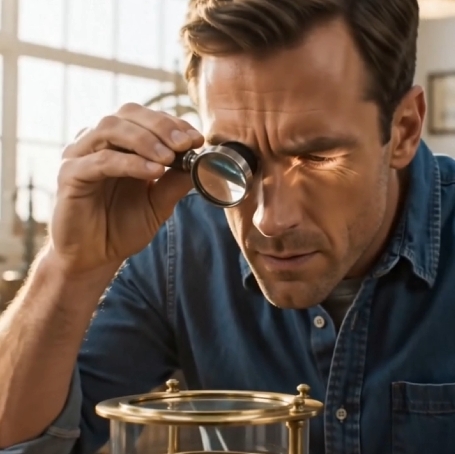
Julian set his magnifying loupe down on the velvet mat with a patient smile. “The digital tracking array on the navigation console requires absolute mechanical balance, Ma. If the pivot point has even a microscopic friction drag, the modern satellite receivers won’t calibrate.”
“Satellites only look at where you are, boy,” Eleanor said, lifting a pair of solid silver drafting compasses from a velvet-lined mahogany box on her lap, the polished metal gleaming in the sun. “They don’t tell you how the current wants to slide you off course. Your grandfather plotted the course for the entire regional cargo fleet with nothing but these compasses and a paper chart. He didn’t hide from the fog; he measured it.”
“I know, Ma,” Julian said softly, stepping around the workbench to sit across from her. “But the modern fleet management accounts are what keep this workshop running. If we don’t prove we can seamlessly service these new automated navigation arrays, the shipping lines will contract out to the big corporate firms down the coast.”
Eleanor gently placed the silver compasses into his palm, her hands radiating warmth. “Take them, Jules. Use them to verify the true centerline by hand. I was saving them for the year you forgot that the soul of navigation is human judgment, not a digital readout. The corporate firms can copy an algorithm, but they can’t copy your instincts.”