What happens in the video
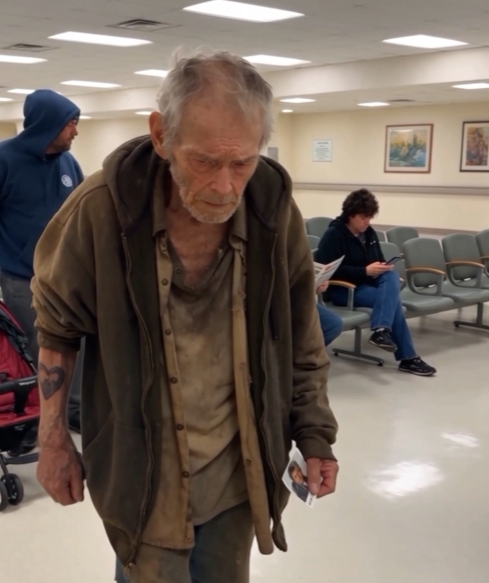
An older man in worn clothing approaches a counter in a busy waiting room while holding a small card bearing an image. A female uniformed employee touches his shoulder and speaks closely to him. He gestures and holds his forearm while people watch. Near the end, a person in blue medical-style clothing approaches from behind. The card’s purpose and the outcome are not shown.
Continuation:
Peter had kept the appointment card in his hand since leaving the bus. He knew that if he put it away, he would spend the whole journey worrying about which pocket held it.
At reception, he waited for a gap in the conversation. When nobody looked up, he moved a little closer to the desk.
A uniformed employee intercepted him.
“You need to wait your turn.”
Peter nodded and tried to show her the card.
“My appointment—”
“Everyone here has an appointment.”
A few people turned towards them. Peter lowered his hand. He had arrived early because the building confused him, and now he was afraid of being marked late while standing at the wrong desk.
The employee, Denise, had spent the morning directing people away from a closed reception window. She thought Peter was ignoring a sign. Peter had never seen it; a queue of standing visitors blocked it from view.
He tried again, this time pointing at the card. His voice grew louder because the room was noisy, and Denise mistook that for aggression.
A nurse named Oliver approached before the exchange worsened.
“May I see what you’ve brought?”
Peter handed him the card with relief.
It was for a clinic on the next floor. The entrance instructions had changed since the card was printed. Oliver explained where Peter needed to go and contacted the clinic to say he had arrived.
“You won’t lose your place because we gave you confusing directions.”
Peter’s face changed. Until then, nobody had realised that was what he feared.
Denise read the old instructions. She apologised for assuming he had ignored the current signs and asked a colleague to make the closed-window notice visible.
Peter accepted the apology, but he still wanted someone to show him the lift. Oliver arranged an escort who walked at his pace and spoke to him directly.
Upstairs, the receptionist checked him in. She asked how he preferred to receive reminders and updated the directions on his next appointment letter.
The consultation itself remained private. Peter did not owe the waiting room a moving explanation of his health or his past to justify being treated with patience.
When he left, he bought a sandwich and sat outside beneath a tree. His daughter called to ask whether he had managed to find the clinic.
“Eventually,” he said. “The instructions needed more help than I did.”
She laughed, and he did too.
Before his next visit, Peter checked the new letter. It described the correct entrance, floor, and desk in three short lines.
He arrived, followed them, and sat down with time to spare.