What happens in the video:
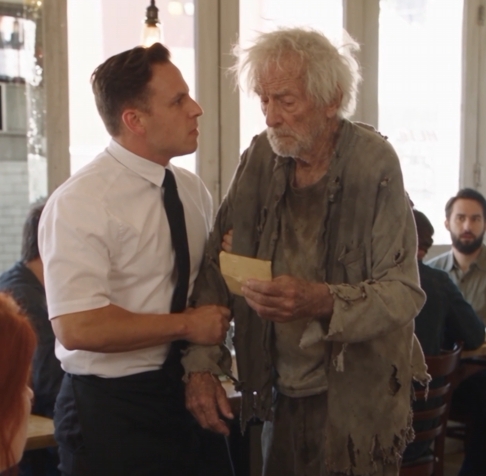
An elderly man in heavily worn clothing stands among occupied restaurant tables, holding a yellowish paper or envelope. A white-shirted employee stands close beside him, appearing to hold or guide his arm during a confrontation. Diners watch. A second employee wearing a dark waistcoat approaches and joins the exchange. The video ends before the situation is resolved.
Extended story:
Arthur had come at the wrong time.
At least, that was what the manager kept telling him.
Lunch service was busy. Tables were full. Nobody had time to hear why an elderly stranger was standing in the dining room with an envelope.
“I only need to give this to someone.”
The manager began steering him toward the door.
Then a waiter approached.
“What’s the name on it?”
Arthur turned the envelope around.
“Daniel.”
The waiter stopped.
“That’s me.”
Inside was a wallet and a handwritten note.
Two nights earlier, Daniel had bought Arthur a hot meal after finishing his shift. He had sat beside him at a bus stop while they ate, then hurried away to catch the last bus home.
His wallet had slipped beneath the bench.
Arthur found it afterward.
He had spent the following morning asking at nearby cafés before someone recognized the restaurant name on Daniel’s staff card.
Daniel opened the wallet. His bank cards were there. So was the cash he had withdrawn for his mother’s groceries.
“You brought everything back.”
Arthur looked puzzled.
“Of course.”
The manager released his arm.
For several seconds, the only sounds came from the kitchen.
Then Daniel pulled out a chair.
“Have you eaten?”
Arthur hesitated. “I didn’t come for another meal.”
“I know.”
Over lunch, Arthur mentioned that the hardest thing about his days was how rarely anyone spoke to him.
The following Thursday, Daniel met him at the same bus stop—with two sandwiches and time to stay.