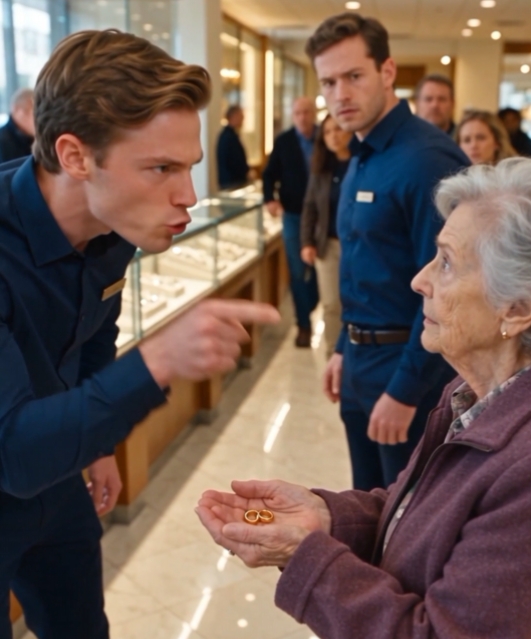
“Those rings are not ours.” In a jewelry shop, a young employee leans toward an older woman wearing purple. Several rings rest in her open palm. “My daughter left them here,” she says.
“That is impossible.”
“Look at the initials.” Another employee peers over his colleague’s shoulder. Some speech during their examination is indistinct. The younger man then tells her to put the rings away. An older suited man approaches, looks at her hand and takes a closer look. The clip ends before he identifies the rings or resolves her request.
The story continues:
The manager fetched a padded tray and asked the woman to sit. “Tell me your daughter’s name.”
“Claire Mason. She brought these in before Christmas.”
He searched the records while she rested her hands on the table. Her daughter had collected the rings after a cleaning, but one engraving had become difficult to read. The woman had returned hoping the shop could clarify it before she passed the rings to her grandchildren.
The younger employee had assumed she was claiming the shop owed her jewelry. He hadn’t asked why she had brought the rings she already possessed.
The manager found the record. Claire’s name appeared beside the description of three family rings. The initials inside matched the photograph attached to the job.
The woman let out a breath. “I knew she’d been here. She wrote the name on the envelope.”
Her daughter had died in the spring. Since then, sorting her belongings had become a series of small mysteries. Keys without labels. Photographs without dates. A recipe book containing telephone numbers. Every solved detail felt like recovering a little piece of a conversation.
The employee brought a magnifier and apologized. “I misunderstood, then kept talking instead of asking.”
She accepted. “Can you help me write down which is which?”
They spent half an hour at the table. One ring had belonged to her mother, one to her sister, and one had been Claire’s own. The manager printed the old photograph. The younger man drew three circles on a sheet and wrote the initials beside each.
When she left, the rings were in separate little envelopes. On every envelope was a name and a story.
That Sunday her grandchildren came for lunch. She placed the envelopes on the table after the plates were cleared. They opened them slowly. One grandson asked why his great-grandmother’s ring was so thin.
“She wore it every day,” she said. “Even when she was making bread.”
The question led to another, then another. By late afternoon the rings were still on the table, but the family had moved on to stories about kitchens, holidays, and the aunt who hid birthday money inside socks.
A week later the woman returned to the shop with a photograph of that lunch. The employee recognized the envelopes. She asked him to put the picture with the old record. Now there was one more page explaining where the rings had gone.