The commuter train was delayed by forty minutes due to a signal failure outside the terminal. The passengers on Platform 4 sat or stood in various states of simmering fury.
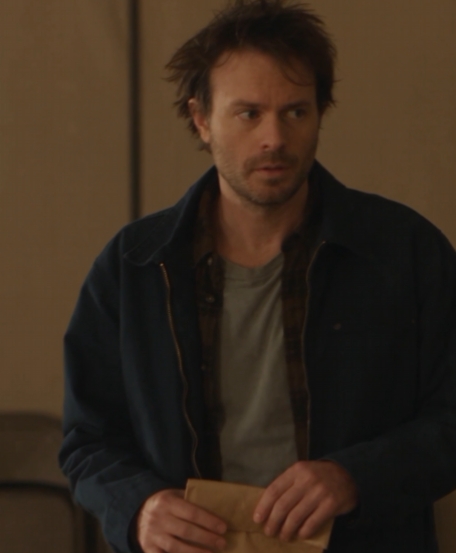
Julian sat on a bench, his bespoke Italian suit protected from the grime by a pristine wool overcoat. He kept checking his platinum watch every thirty seconds, his jaw clenched so tightly his teeth ached. He was losing a three-million-dollar acquisition because of a rusted copper wire somewhere in the transit grid.
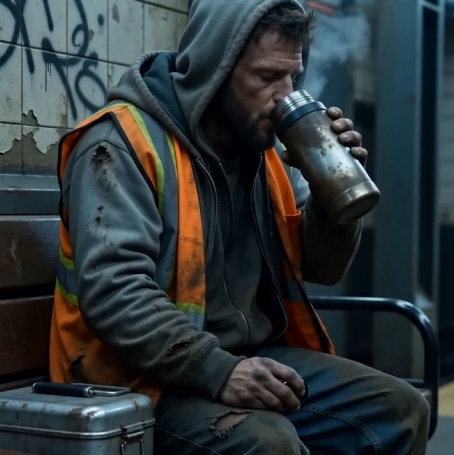
On the other end of the same wooden bench sat Marcus. Marcus wore a faded neon-orange construction vest over a frayed gray hoodie. His steel-toed boots were caked with dried mortar, and his lunchbox—a dented metal Aladdin model from the nineties—rested between his feet.
Julian let out a loud, theatrical curse, slamming his briefcase down onto the bench. “Unbelievable. Absolutely incompetent. A first-world city run like a third-world village.”
Marcus turned his head slowly, his face calm, eyes deep-set and relaxed. “Could be worse, chief. At least it ain’t raining on us.”
Julian glared at him, annoyed by the casual familiarity. “Worse? My friend, every minute this train doesn’t arrive costs me thousands of dollars. Time is money.”
Marcus took a thermos out of his lunchbox and unscrewed the cap, pouring a cup of steaming, bitter-smelling chicory coffee. “If time is money, you must be a billionaire. Me? I just see time as time.”
“That is exactly why you are sitting there in a safety vest and I am trying to save an international merger,” Julian retorted, his frustration boiling over into arrogance. “The difference between success and mediocrity is how you value the clock.”
Marcus took a slow sip of his coffee, unbothered by the insult. “Maybe. But here’s the thing, mister. We’re both sitting on the exact same bench, waiting on the exact same train. Your three million dollars can’t make that signal light turn green any faster than my twelve-dollar-an-hour wage can.”
Julian opened his mouth to reply, then stopped. He looked at Marcus, then down at the tracks. The logic was annoyingly sound. He adjusted his tie, his tone shifting from angry to defensive. “That’s a simplistic way of looking at it. The downstream consequences are different. If I miss this meeting, people lose jobs.”
“If I miss my shift, I lose mine,” Marcus said simply. “And if I lose mine, my daughter doesn’t get her inhaler refill this Friday. So don’t talk to me about downstream consequences like you got a monopoly on trouble.”
The silence that followed was heavy. Julian looked at the man’s hands—they were thick, the skin stained with black grease that had settled into the permanent lines of his palms. Julian looked at his own hands: smooth, manicured, smelling of expensive sandalwood soap.
“I apologize,” Julian said after a moment, the words tasting strange in his mouth. “That was… uncalled for. I’m under a significant amount of pressure.”
Marcus nodded, accepting the apology with a short tilt of his chin. “We’re all under pressure, partner. The world’s a big hydraulic press. Just depends on which part of the piston’s hitting you.” He held out the thermos cap. “Want some? It’s hot, anyway.”
Julian hesitated. He hadn’t drunk black coffee from a plastic cup since his university days twenty-five years ago. He looked at his watch again. The train was still nowhere in sight.
“Thank you,” Julian said, taking the cup. The plastic was warm against his fingers. He drank. It was harsh, burnt, and incredibly strong. “Wow. That has some kick to it.”
“Keep you awake through a twelve-hour pour,” Marcus said, smiling. “So, what’s the merger about? If you don’t mind a poor man asking.”
“Logistics,” Julian said, finding himself surprisingly willing to talk. “Warehouse automation. Eliminating human error in the supply chain.”
“Human error,” Marcus repeated, reflecting on the words. “That’s what they call it when a guy gets tired because he’s been on his feet for ten hours and misses a label, huh?”
“From a balance sheet perspective, yes,” Julian said, though the phrase suddenly sounded cold even to him.
“Well, the balance sheet don’t see the guy’s kid having the flu, keeping him up all night before his shift,” Marcus said softly. “You can automate the warehouses, mister, but you can’t automate the reason people go to work in the morning.”
Julian looked at the man for a long time. For the last ten years, his world had been populated exclusively by people who agreed with him, people who spoke in metrics, deliverables, and margins. He had forgotten that the metrics were built on top of people like Marcus.
A distant hum vibrated through the rails. The yellow headlights of the commuter train appeared around the curve, cutting through the damp station gloom.
Julian handed the plastic cap back to Marcus. “Thank you for the coffee. And the conversation.”
Marcus screwed the cap back onto his thermos and stood up, lifting his heavy lunchbox. “Don’t worry about that meeting too much, chief. If it’s a good deal, it’ll still be a good deal forty minutes from now. And if it ain’t, you just saved yourself three million bucks.”
Julian smiled—a genuine, relaxed smile that didn’t appear in his corporate portraits. “You might be right.”
As the train doors hissed open, Julian stepped back to let Marcus board first. The construction worker nodded in appreciation, his orange vest disappearing into the crowded car. Julian followed, his watch still ticking, but the weight of the seconds felt slightly different now.