What happens in the video:
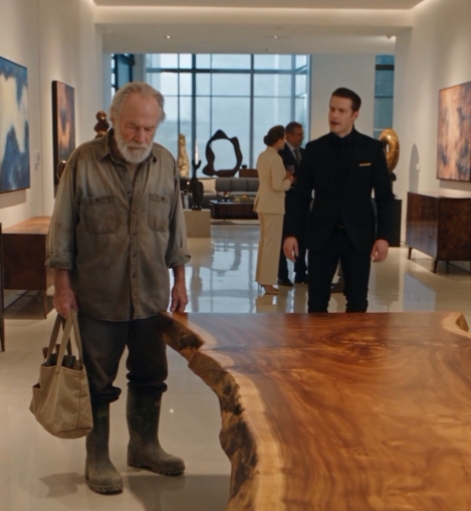
An elderly man in worn work clothes enters an exhibition-like space carrying a tool bag. He stops beside a large polished wooden table with a natural, uneven edge and sets down his bag. A younger man in dark clothing speaks with him. Towards the end, a woman in a light suit approaches and smiles. The clip does not explain the visitor’s connection to the table.
Imagined story and continuation:
The first thing Joseph noticed was the light.
It caught the table’s grain exactly as he had hoped, following the amber lines from one end to the other. He stopped beside it and set his tool bag on the floor.
A young gallery employee approached.
“The delivery entrance is around the back.”
“I’m not delivering anything.”
Joseph looked along the edge, then crouched slightly to inspect one of the joints.
“Please don’t adjust the display.”
He straightened.
“I came to check it had settled properly.”
The employee seemed uncertain whether that was an explanation or another problem.
Before he could respond, a woman in a cream suit crossed the room.
“Joseph! I was hoping you’d bring your tools.”
She was the exhibition organiser. Joseph had built the table from timber recovered after a storm brought down an old tree on the town’s recreation ground.
The employee glanced at the tool bag.
“You made this?”
“With help,” Joseph said. “Quite a lot of it.”
The organiser had commissioned the piece to mark the reopening of the community hall. Joseph worked with two apprentices, a local sawmill and volunteers who helped move the heavy timber.
He insisted that all their names appear beside the display.
The employee apologised for assuming he was using the wrong entrance.
Joseph nodded, then pointed beneath the table.
“Now, may I check that?”
With permission, he inspected the fitting he had been concerned about. Everything was secure.
The organiser asked him to stay for the opening. Joseph looked down at his dusty sleeves.
“I didn’t come dressed for speeches.”
“You came dressed for making things.”
He agreed, on the condition that the apprentices stand beside him.
During the reception, visitors asked about the unusual edge and the dark line running through the centre. Joseph explained that the wood had carried those marks before it ever reached his workshop.
“We could have cut them away. But then we’d have lost half the reason for using it.”
One apprentice described the hours spent sanding. The other admitted that he had once fitted a piece backwards.
Joseph laughed.
“Only once?”
The young employee listened from the edge of the group. Afterwards, he asked whether the workshop accepted visitors.
“Thinking of learning?” Joseph asked.
“Possibly.”
“Come on Saturday. Wear clothes you don’t mind ruining.”
Weeks later, the table was installed in the community hall. At its first public lunch, Joseph watched children spread drawing paper across the polished surface.
Someone worried about scratches.
Joseph shook his head.
“It’s a table. Let them use it.”
Beside him, the gallery employee—now a Saturday workshop regular—helped a child find a pencil.
The table had finally begun its real work.