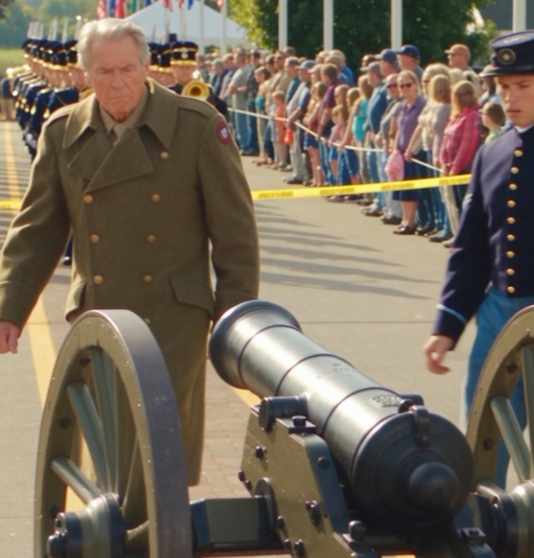
“Please clear the demonstration area.” At a public event lined with flags and spectators, an older man in a long green coat stands near a wheeled cannon. A reenactor in a dark blue uniform gestures for him to move.
“That carriage isn’t secured,” the older man says. An event official approaches and calls for the salute to be held. Part of that instruction is indistinct. The older man points toward the wheel and the block on the ground. “It’s rolling even with the brake on.” The official and reenactor look down at the carriage. The clip ends before the inspection is completed.
The story continues:
The announcer asked spectators to stay behind the barrier while the demonstration crew checked the equipment. For the first time all morning, the band stopped playing. Into the sudden quiet came a small child’s voice.
“Is it broken?”
The older man turned. “Something needs checking.”
He had spent years restoring farm machinery. What caught his attention was a wheel moving when everyone around it assumed the carriage was still. He’d stepped forward because the nearest crew member hadn’t heard his first warning over the music.
The event official introduced himself and asked the man to explain exactly what he’d seen. His name was Walter. He described it without embellishment, pointing from a safe distance while the crew took charge of securing and inspecting the display.
The reenactor who had tried to send him away came back after the equipment was taken out of service. “You were right to speak up. I should have asked what you meant.”
Walter nodded. “Hard to hear anything with the trumpets going.”
The salute was postponed. In its place, the crew answered questions about the display. The little boy from behind the barrier asked more than anybody. Why were the wheels so large? How heavy was it? Did the uniforms itch?
Walter sat on a bench while the questions continued. His granddaughter brought him tea. She had persuaded him to attend because he’d been spending too many weekends alone in his workshop. He’d expected to look around for an hour and leave.
By lunchtime he was discussing old wheelwrights with a volunteer who had three photographs on his phone and no one at home interested in them. Walter had six photographs of his own. They missed the next band performance entirely.
A month later the event committee invited him to a workshop open day. He agreed to come as a visitor. He liked the idea of seeing the restoration work without having to carry a toolbox.
The little boy was there with his father. He recognized Walter immediately. “That’s the man who noticed the wheel!”
Walter smiled, then asked what the boy had noticed that morning. The child pointed out a loose lace on his father’s shoe.
His father looked down, laughed, and tied it before they went any farther. Walter took his tea to the nearest chair. Around him, people were looking carefully at things they might otherwise have walked past, and that was a pleasant way to spend a Saturday.