The little boy had only seventy-three cents.
He placed the coins on the counter with trembling fingers and asked for one meal—not for himself, but for his younger sister waiting outside.
My manager laughed.
Then he grabbed the child by the shoulder and forced him toward the door.
What none of us knew was that the quiet older man sitting in the corner owned the entire building.
But even he wasn’t prepared for what the boy said after recognizing him.
“My mother told me to find you, Mr. Harrison.”
The owner froze.
“What’s your mother’s name?”
The boy whispered it.
And every trace of color disappeared from the old man’s face.
Because the child’s mother had supposedly died nine years earlier.
The Boy at the Door
My name is Emily Carter, and I worked evenings at Miller’s Diner, a small restaurant outside Nashville.
It wasn’t glamorous.
The booths were cracked, the coffee was strong, and the old neon sign flickered whenever it rained.
But people liked the place.
Truck drivers stopped there after long shifts. Elderly couples shared pie by the window. Parents brought their children on Friday nights because our pancakes were cheap and our servers remembered their names.
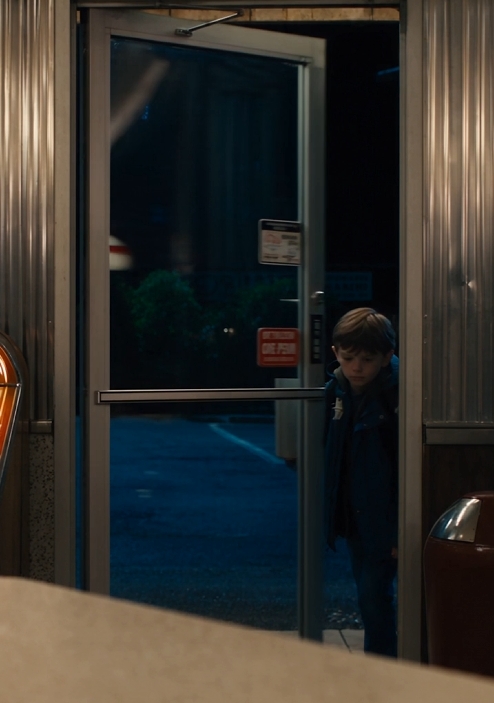
It was almost closing time when the front door opened.
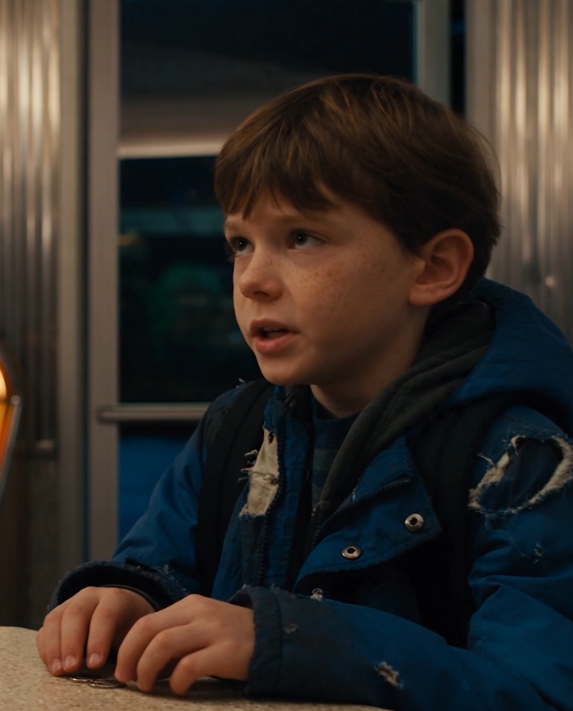
A little boy stood beneath the bell.
He looked about eight.
His blue jacket was too thin for the cold, and the sleeves stopped above his wrists. Mud covered his sneakers. He carried an old backpack with one broken strap.
He didn’t approach the counter.
He simply stared at the unfinished plates on the tables.
My manager, Rick Dalton, noticed him immediately.
“What do you want?”
The boy flinched.
His eyes moved toward a plate containing half a sandwich and untouched fries.
“Do you have any food you’re throwing away?”
The diner became quieter.
Rick pointed toward the door.
“Get out.”
The boy swallowed.
“Please, sir. I haven’t eaten today.”
I reached for a clean plate.
Rick stepped in front of me.
“What are you doing?”
“We have food left in the kitchen.”
“We also have rules.”
“It’s going into the trash.”
“That doesn’t make it his.”
The boy reached into his pocket and carefully removed several coins.
He counted them twice before placing them on the counter.
Two quarters.
Two dimes.
Three pennies.
Seventy-three cents.
“This is all I have.”
Rick looked at the coins and laughed.
“You think this is a charity?”
The boy lowered his head.
“No, sir.”
“Then leave.”
He gathered the coins with shaking fingers.
Before returning them to his pocket, he whispered:
“My little sister is hungry too.”
Something inside me broke.
“Where is she?”
The boy pointed through the front window.
Beneath the weak light of a closed gas station across the road, I saw a tiny figure sitting beside two backpacks.
A little girl.
She couldn’t have been older than five.
She was hugging her knees to keep warm.
I started around the counter.
Rick caught my arm.
“You’re still working.”
“They’re children.”
“They’re not our responsibility.”
I pulled away.
“That doesn’t mean we let them starve.”
Rick’s expression hardened.
“Give away one meal, and tomorrow there will be ten people at that door.”
“Then tomorrow we’ll handle ten people.”
Several customers turned toward us.
Rick realized they were watching.
Instead of softening, he became angrier.
He marched toward the boy and grabbed his shoulder.
“I told you to leave.”
The child cried out.
“Don’t touch him!” I shouted.
The boy tried to pull away.
He lost his balance and fell beside an empty table.
Chairs scraped across the floor as several customers stood.
The boy crawled backward, terrified.
Rick opened the front door and pointed into the cold.
“Don’t ever come back.”
The boy slowly climbed to his feet.
His lower lip trembled, but he refused to cry.
Then a chair moved in the darkest corner of the diner.
The Man With the Keys
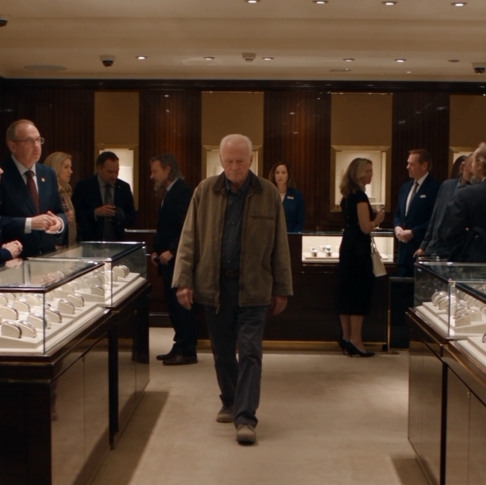
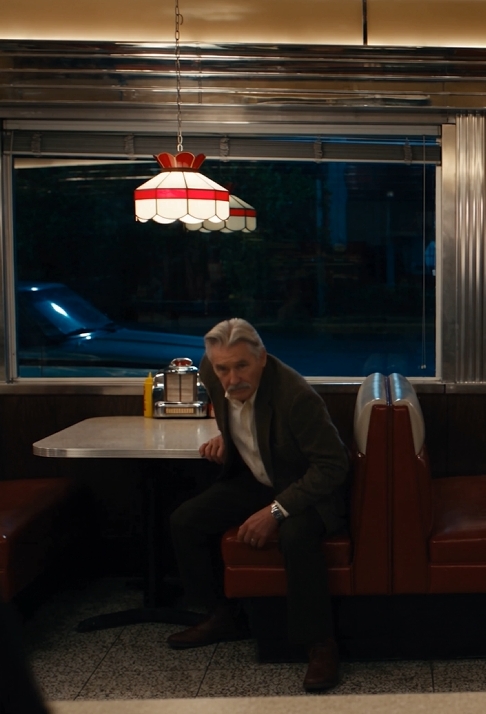
An older man had been sitting alone in Booth Twelve for nearly an hour.
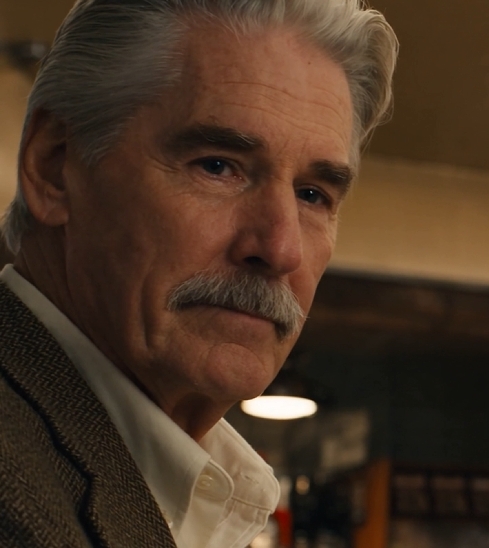
He wore a charcoal coat and a faded green scarf. His silver hair was neatly combed, and a wooden cane rested against the table.
He had ordered black coffee and apple pie.
Until that moment, he hadn’t said a word.
He stood, picked up his cane, and walked toward Rick.
His voice was calm.
“Close the door.”
Rick stared at him.
“This doesn’t involve you.”
The man placed a set of brass keys on the counter.
Rick looked down.
His entire expression changed.
Attached to the keys was a small metal tag bearing the address of the diner.
“You…” Rick whispered.
The old man looked at the frightened child.
Then back at Rick.
“My name is Thomas Harrison.”
Several customers recognized it.
I didn’t—not immediately.
Rick did.
Thomas Harrison owned the building.
In fact, his family owned most of the small commercial properties along that road.
Rick had been negotiating a new lease with him for months.
Thomas calmly removed his gloves.
“You will step away from that child.”
Rick’s voice changed instantly.
“Mr. Harrison, this isn’t what it looks like.”
“I watched the entire thing.”
“He came in begging customers.”
“No,” Thomas replied. “He asked whether you were discarding food.”
“We can’t feed every person who walks through the door.”
“Perhaps not.”
Thomas looked toward the boy.
“But you could have answered without humiliating him.”
Rick forced a nervous smile.
“This is my business.”
Thomas glanced at the keys.
“And this is my building.”
The room went completely silent.
Rick lowered his voice.
“Are you threatening my lease?”
Thomas didn’t answer.
Instead, he crouched carefully in front of the boy.
“What’s your name?”
“Jacob.”
“Is your sister really outside?”
Jacob nodded.
Thomas looked toward me.
“Bring her inside.”
Rick stepped forward.
“Mr. Harrison—”
Thomas raised one hand.
“You’ve said enough.”
I hurried across the road.
The little girl initially backed away from me.
“It’s okay,” I said gently. “Your brother sent me.”
She looked toward the diner window.
“Jacob?”
“He’s safe.”
Her name was Lily.
She carried a plastic grocery bag containing one sweater, two children’s books, and an empty water bottle.
When I brought her inside, Jacob ran to her.
“I found food,” he promised.
He hadn’t.
Not yet.
But I understood why he said it.
He was her big brother.
He needed her to believe he could protect her.
I asked the cook to prepare two plates.
Rick tried to object.
Thomas looked at him once.
Rick said nothing.
The children ate so quickly that I had to remind them to slow down.
Jacob divided everything evenly.
Even the bacon.
Even though Lily kept trying to give him the larger pieces.
Thomas watched from the counter.
Then Jacob noticed the older man’s face properly.
His fork stopped halfway to his mouth.
“Are you Mr. Harrison?”
Thomas turned.
“Yes.”
Jacob slowly reached into his backpack.
“My mom told me to find you.”
The keys slipped from Thomas’s hand.
The Name That Should Have Been Impossible
Thomas approached the booth.
“What’s your mother’s name?”
Jacob hesitated.
“She said I shouldn’t tell anyone unless I found the man with the silver watch.”
Thomas looked down at the antique watch chain crossing his vest.
His hands began to shake.
“Your mother knows about this?”
Jacob nodded.
“She said your wife gave it to you when your daughter was born.”
Thomas gripped the counter for support.
Only someone close to his family could have known that.
“Tell me her name.”
Jacob leaned closer and whispered:
“Sarah Harrison.”
Thomas went completely still.
Rick frowned.
“Who’s Sarah?”
Thomas didn’t answer.
I saw pain spread across his face.
Not surprise alone.
Grief.
“Sarah was my daughter,” he finally said.
The diner fell silent.
“She disappeared nine years ago.”
According to the police, Sarah’s car had been found near a river after a violent storm.
Her purse was inside.
The driver’s door was open.
No body was ever recovered.
After years without evidence, the family had accepted that she was dead.
But Jacob was eight.
If Sarah was his mother, she had survived.
“Where is she?” Thomas asked.
Jacob’s eyes filled with tears.
“She’s sick.”
“How sick?”
“She couldn’t get out of bed this morning.”
“Where are you staying?”
Jacob reached into his backpack and removed a folded paper.
It contained an address written in weak, uneven handwriting.
Thomas recognized the handwriting instantly.
He pressed one hand against his mouth.
At the bottom of the note were five words:
Dad, I’m ready to come home.
Thomas sat down heavily.
For nine years, he had believed his daughter was gone.
Now her son was sitting inside his building, eating discarded food because Sarah had been too afraid to contact him directly.
“Why didn’t she call me?” he asked.
Jacob looked toward Rick.
Then he lowered his voice.
“She said a bad man checks her phone.”
Rick suddenly stopped moving.
Thomas noticed.
So did I.
“What man?” I asked.
Jacob studied Rick’s face.
Then he slowly pointed at him.
“That’s him.”
Rick’s Real Secret
Rick laughed too quickly.
“This kid is confused.”
Jacob immediately moved closer to Lily.
“I’m not.”
“I’ve never seen him before.”
“Yes, you have,” Jacob replied. “You came to our motel last night.”
The room tightened around us.
Thomas looked at Rick.
“Do you know my daughter?”
“No.”
Jacob reached into his backpack again.
This time, he removed a photograph.
Sarah stood beside the two children outside a motel.
In the background, reflected in a window, was Rick.
Thomas held up the picture.
Rick’s face turned pale.
“What were you doing there?”
Rick moved toward the exit.
One of the truck drivers stood and blocked the door.
Nobody touched Rick.
Nobody needed to.
Thomas took out his phone.
“I’m calling the police.”
Rick’s calm disappeared.
“You don’t understand.”
“Then explain.”
Years earlier, Rick had worked for Thomas’s property company.
Sarah discovered that he had been stealing tenant deposits and falsifying repair invoices.
She planned to expose him.
Before she could, Rick threatened her.
He convinced her that her father was involved and that reporting the fraud would place the entire family in danger.
Terrified and pregnant, Sarah disappeared.
For years, Rick used money and threats to keep her moving between cheap motels.
But Sarah had recently discovered the truth:
Her father had never been involved.
Rick had lied about everything.
She sent Jacob to find Thomas because Rick had taken her phone and planned to move them again that night.
Rick looked around the diner.
“You’re believing a child?”
Thomas held up Sarah’s note.
“I believe my daughter.”
Sirens sounded in the distance.
Rick turned toward me.
“You called them?”
I shook my head.
The teenager seated near the window raised his phone.
“I did.”
Rick stared at the customers who had watched silently when Jacob first entered.
None of them looked away now.
The Door Sarah Thought Was Closed
Thomas drove to the motel with the police.
I went with him to help care for the children.
Sarah was found weak and feverish but alive.
When Thomas entered the room, she looked at him as though he were a ghost.
“Dad?”
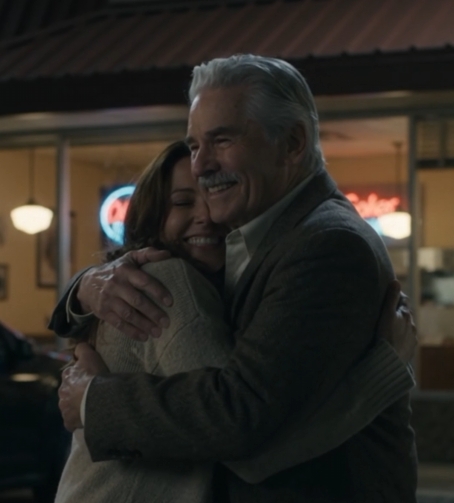
He crossed the room and held her.
For a long time, neither spoke.
Then Sarah began apologizing.
For disappearing.
For believing Rick.
For keeping the children away.
Thomas stopped her.
“You survived,” he whispered. “That’s all you need to explain tonight.”
Rick was arrested after investigators found messages, financial records, and threats stored on his phone.
His crimes went far beyond the stolen deposits.
He had used Sarah’s identity to hide money and convince her that returning home would send her to prison.
The evidence Jacob carried in his backpack exposed everything.
But Thomas made one more discovery.
Jacob hadn’t entered Miller’s Diner by accident.
Sarah had sent him there because she remembered that Thomas collected rent personally on the first Monday of every month.
She knew he often ended those evenings with coffee and pie in Booth Twelve.
Jacob had not merely been searching for food.
He had been searching for his grandfather.
What Happened to the Diner
Rick lost the restaurant and his freedom.
Thomas could have closed the diner.
He didn’t.
Instead, he offered me the chance to manage it.
I laughed because I thought he was joking.
“I’m a waitress.”
“You saw two hungry children before you saw a problem,” he replied. “That’s more management ability than the last man demonstrated.”
We renamed Booth Twelve the Harrison Table.
Every evening, one meal was quietly reserved for someone who needed it.
No questions.
No photographs.
No humiliation.
Sarah eventually recovered and returned to school.
Jacob and Lily moved into Thomas’s home.
On Saturday mornings, they ate pancakes at the diner.
Jacob always carried seventy-three cents in his pocket.
I once asked why.
“So I never forget.”
“Forget what?”
He looked toward the door where Rick had tried to throw him out.
“That being unable to pay doesn’t mean you’re worth nothing.”
Years later, people still told the story incorrectly.
They said a poor boy entered a diner asking for food and was rescued by a wealthy man.
But that wasn’t what really happened.
Jacob rescued Thomas from nine years of grief.
He rescued his mother from the man controlling her.
And he exposed a secret that powerful adults had failed to uncover.
All because, on one cold evening, an eight-year-old boy walked through a diner door carrying seventy-three cents, an empty stomach, and the courage to say:
“My mother told me to find you.”