The old cabin smelled of dry pine and thirty years of woodsmoke.
David held the end of the tape measure against the log wall, his thumb pressing the silver metal flat.
“Fourteen feet, six inches,” David called out.
Across the room, his father, Thomas, didn’t write it down.
He was sitting on a three-legged stool, his hands wrapped around a mug of black coffee that had long since gone cold.
His eyes were fixed on the floorboards. “Dad? Did you get that? Fourteen-six.”
Thomas blinked, clearing his throat. “Yeah. Fourteen-six.
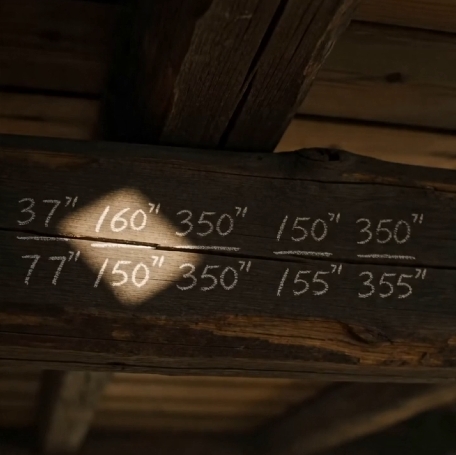
Write it on the beam, Dave. Like we used to.”
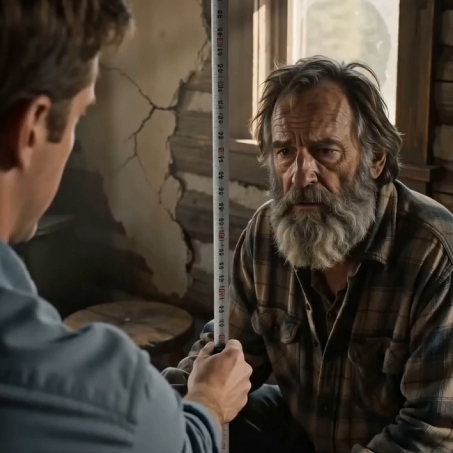
David lowered the tape measure, the metal snapping back into its casing with a sharp clack.
“We aren’t keeping the cabin, Dad. The surveyors need the exact dimensions for the listing.
Writing it on the beam doesn’t do anyone any good.” Thomas didn’t look up.
“The buyers won’t care about a bit of pencil on the wood. It’s cedar. It absorbs things.”
David took a deep breath, trying to keep the impatience out of his chest.
He was thirty-five, a project manager for a commercial firm in the city; he dealt with blueprints, deadlines, and concrete.
Returning to the mountain woods always made him feel like he was wearing clothes three sizes too small.
“We talked about this,” David said, stepping over a pile of old tarps. “The maintenance is too much for you.
The roof needs a complete tear-off before winter, and the well pump is failing.
You can’t be hauling water at seventy-four.” “I’ve hauled water my whole life, David.
It keeps the blood moving.” “Until you slip on the ice like you did in January,” David said, his voice rising slightly before he caught himself.
“You lay out here for two hours before the neighbor checked on you.
If you hadn’t managed to crawl to the porch—” “I did crawl to the porch,” Thomas interrupted, his voice dropping into that low, stubborn register David knew too well.
“And I didn’t die. A man shouldn’t leave his home just because he had a clumsy afternoon.”
David sat down on an upturned milk crate opposite his father.
The space between them felt vast, filled with the ghosts of summers spent cutting firewood and autumns spent tracking deer they rarely shot.
“It’s not just the ice, Dad. It’s everything. I can’t come up here every weekend to fix things.
I have a family now.
Leo’s starting school next month.”
At the mention of his grandson, Thomas’s expression softened, the hard lines around his mouth relaxing slightly.
“How is the boy? Still afraid of the dark?” “He’s getting better.
We got him one of those star-projector lamps.” David smiled faintly.
“He thinks the ceiling is the night sky.” Thomas looked out the small window toward the dense treeline.
“You don’t need a projector out here. You just look up. The stars look like they’re going to drop right into your pockets.”
“He lives in a suburb, Dad. There’s streetlights.” “Shame,” Thomas muttered. He set his coffee mug down on the floor.
“You remember when we built this porch? You were twelve. Kept dropping the galvanized nails between the joists.
I bet there’s fifty pounds of steel down there in the dirt.”
“I remember hitting my thumb with the framing hammer,” David said, touching his left hand reflexively.
“You told me to stop crying or the noise would sour the lumber.”
Thomas chuckled, a dry, raspy sound. “I didn’t say that.”
“You absolutely did. You said timber is alive until you paint it, and it don’t like complaints.”
“Well,” Thomas said, looking at his own massive, calloused hands.
“Maybe I was a bit hard on you back then. I didn’t know any other way to be.
My old man used to use a belt if a fence line wasn’t straight.
I thought I was being gentle.” David looked at his father’s profile—the eagle-hook nose, the heavy brow, the shoulders that had begun to curve inward like an old oak giving in to the wind.
The anger that had been simmering in him since the drive up the mountain suddenly evaporated, replaced by a dull, aching grief.
“You were gentle enough, Dad,” David said softly. Thomas turned his head, looking directly at his son for the first time all morning.
His eyes were watery but clear. “I don’t want to live in that apartment you showed me, Dave.
The one with the yellow walls and the view of the supermarket parking lot. It smells like someone else’s laundry.”
“It’s safe, Dad. There’s a nurse on call, and the heating is included.” “Safe is for people who are waiting to die,” Thomas said.
“I’m not done yet. I still want to smell the pine in the morning. Even if the well pump is broken.
Even if I have to carry the buckets one pint at a time.” David looked down at his boots, then around the cabin.
He saw the notch in the doorframe where his height had been measured every summer.
He saw the black smudge on the hearth where they’d roasted marshmallows after the great storm of ’98.
“What if…” David hesitated, clearing his throat. “What if we didn’t sell it?” Thomas didn’t move.
“What do you mean?” “What if we hire a local contractor to fix the pump and do the roof?
I can handle the billing from the city. And we can keep it as a weekend place.
You live here during the spring and summer, and when the snow starts, you come stay with us.
We have the guest room. Leo would love to have you. You could show him the real stars.”
Thomas was silent for a long time. A blue jay screeched outside, the sound cutting through the quiet woods.
“Your wife wouldn’t mind?” Thomas asked, his voice tentative. “Elena suggested it three weeks ago,” David admitted with a wry smile.
“I was the one being stubborn. I wanted everything neat. No loose ends.”
Thomas reached out, his hand trembling slightly, and cuffed David gently on the back of the neck, just like he used to when David did something right o n the job site.
“You always were too neat, Dave,” the old man said, a tear finally escaping and lost in his gray beard.
“Get your tape measure out. Let’s finish the dimensions anyway.
If we’re going to fix the roof, we need to know how many squares of shingles to buy.”
“Fourteen-six on the short wall,” David said, his voice steady and strong. “I’ll write it on the beam.”