What happens in the video:
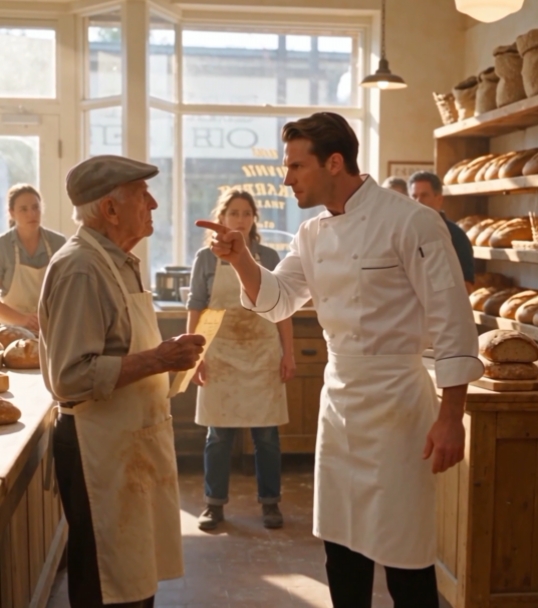
An elderly man wearing a flat cap and apron holds a yellowed handwritten sheet inside a bakery. A younger chef points towards him during a heated exchange. The older man raises the paper as though explaining something. Several people watch, and another man approaches near the end. The document’s meaning remains unclear.
Continuation:
Albert had brought the recipe because the new owner asked for it.
For years, customers had requested the same loaf: dark crust, soft centre, a taste they associated with lunches packed for school and breakfasts at their grandparents’ tables.
The bakery wanted to bring it back.
But when Albert arrived, the young chef looked at the page and shook his head.
“There aren’t enough instructions here.”
“There are enough to begin.”
“That isn’t enough to sell it.”
Albert understood the concern. What stung was the tone, as though the missing details proved he had never known what he was doing.
The argument drew the owner from the office.
He examined the paper, then asked Albert a question nobody else had asked.
“When did you last make it?”
Albert looked towards the ovens.
“Before my wife became ill.”
That had been six years earlier.
The recipe belonged to her family. They had made it together throughout their marriage, dividing the work so naturally that neither wrote every step down.
Now Albert could remember her movements more easily than the measurements.
The owner suggested a trial morning with no customers waiting and no promise that the first attempt would work.
Albert agreed.
The first loaf was too dense. The second tasted close but baked unevenly. By the third attempt, the young chef had stopped treating the paper as a failed set of instructions and started treating Albert as someone worth working beside.
“What did she do next?” he asked.
Albert closed his eyes.
“She covered the bowl with a cloth. The blue one.”
“How long did she leave it?”
“Until after the radio programme.”
They worked backwards from the memory.
Eventually, Albert broke open a loaf and went quiet.
The young chef waited.
“That’s nearer,” Albert said.
He took another piece.
“Much nearer.”
They wrote down every stage of the successful batch. Albert checked it, corrected one detail and asked that his wife’s name be included.
When the loaf returned to the counter, the bakery displayed a simple card describing its history.
Albert came on the first morning and bought one.
“You don’t need to pay,” the owner told him.
“I know. I’d like to.”
At home, he cut a slice and carried it into the garden. For a while, he sat with the taste and the memories it brought.
Then he wrapped half the loaf for his neighbour.
The following week, the young chef called. A new apprentice wanted to learn the method, and he wondered whether Albert would join them.
Albert looked at the clean apron hanging by the door.
“What time?”
“Early.”
“Good,” he said. “Bread always was.”