The Tomatoes Weren’t Free
“Please tell me you didn’t take those from Mr. Harris’s garden.”
Lucy stopped in the kitchen doorway, holding a basket so full of tomatoes that the handle had left a red mark across her palm.
Her mother, Anna, put down the cloth she had been using to wipe the counter.
“He gave them to me,” Lucy said.
“All of them?”
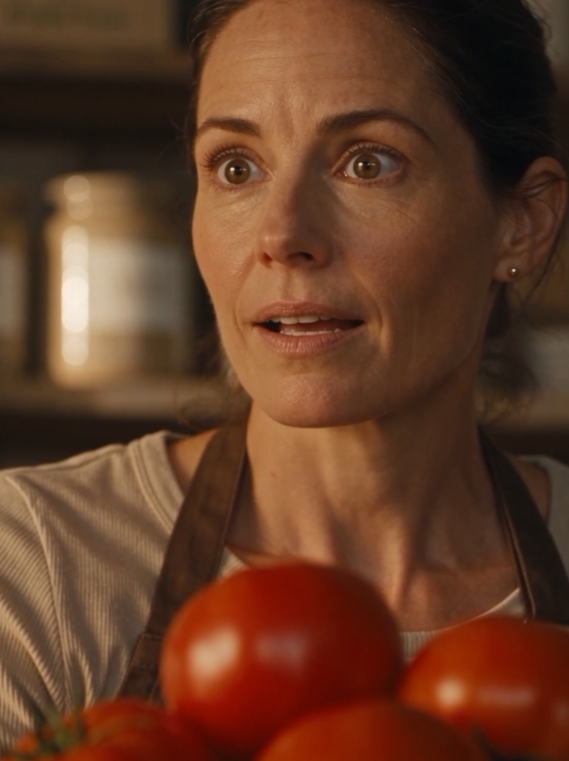
Lucy nodded and lifted the basket onto the counter.
Anna picked up the largest tomato. It was still warm from the afternoon sun.
For three weeks, she had been stretching every meal. Her hours at the bakery had been cut, the car needed repairs, and yesterday she had stood in the grocery store deciding whether they needed milk more than eggs.
A basket like this meant pasta sauce. Soup. Sandwiches with thick red slices and a little salt.
Then she noticed Lucy studying her face.
“What?” Anna asked.
“Nothing.”
“Lucy.”
Her daughter twisted the cuff of her red cardigan.
“He said I could pay him later.”
Anna set the tomato down.
“How much?”
“He didn’t say.”
For a moment, the kitchen was quiet.
Mr. Harris lived behind them, beyond the leaning fence. He was a widower with a beautiful vegetable garden and a reputation for telling children exactly what he thought of footballs landing among his beans.
Anna barely knew him. They exchanged a wave now and then. Once, he had brought her bin in during a storm.
“We can’t agree to buy things without knowing the price,” she said gently.
Lucy lowered her eyes.
“I told him we didn’t have much money.”
Anna felt something tighten in her chest.
“And what did he say?”
“He said he wasn’t asking for money.”
Anna waited.
Lucy glanced toward the window.
“He said if you made something with them, perhaps I could bring him a little.”
The refrigerator hummed behind them.
“He can grow food,” Lucy continued, “but he says he’s not very good at cooking it.”
Anna looked down at the basket again.
There were small yellow tomatoes tucked beneath the red ones, carefully packed so they wouldn’t bruise.
“How did this start?”
“My ball went over his fence.”
“Lucy.”
“I asked before I went to get it.”
“And?”
“He was picking tomatoes. There were loads on the ground, so I helped.”
Anna leaned against the counter.
“Then he asked what you were making for dinner,” Lucy said. “I told him I wasn’t sure.”
For a few seconds, Anna said nothing.
Then she opened the cupboard and took out a saucepan.
“Wash your hands,” she said. “You can help me chop.”
An hour later, the kitchen windows had steamed over.
Anna roasted the tomatoes with the last two cloves of garlic, then stirred them into a thick soup. She found half a loaf of yesterday’s bread, brushed it with oil, and toasted it in a pan.
Lucy hovered beside her as she filled a lidded container.
“Is that enough?”
“For one person? More than enough.”
“Put in another piece of bread.”
Anna did.
They packed everything into a small cardboard box, with a spoon and a folded napkin.
At the back door, Lucy hesitated.
“Are you coming?”
Anna looked at the box.
“I think you made the arrangement.”
Mr. Harris was sitting at the wooden table beside his tomato plants when Lucy opened the gate.
He began to rise.
“Mum says you’re supposed to eat it while it’s hot,” she announced.
“Well, then. Better not keep your mother waiting.”
Lucy placed the box in front of him.
He lifted the lid and went still.
“Tomato soup,” she said. “And bread. The bread’s a little hard, but you dip it.”
“I know how toast works.”
She grinned.
He picked up the spoon, tasted the soup, and looked toward the house beyond the fence.
“Did you help?”
“I washed the tomatoes.”
“Important job.”
“And I told her about the extra bread.”
“Even more important.”
Lucy sat opposite him while he ate.
At first, they talked about the garden. Then he asked about school, and she told him about a girl who kept borrowing her purple pencil and returning it without a point.
By the time she left, the container was empty.
Mr. Harris carried the cardboard box inside.
He washed the spoon immediately.
The napkin stayed on the table.
The next morning, Anna found the clean container on her doorstep.
Inside was a folded note.
Payment received. An excellent arrangement.
Underneath, in smaller handwriting:
Would you happen to need courgettes?
For the first time in several days, Anna laughed.
By the end of the summer, Thursday had become soup day.
Sometimes Anna sent stew instead. Sometimes Mr. Harris supplied potatoes or beans. When there was nothing ready in the garden, he sharpened her kitchen knives or repaired something Lucy had broken.
Neither of them kept count.
Then, one Thursday in November, the container remained on his doorstep.
Lucy noticed it on her way home from school.
She knocked.
No answer.
She ran for her mother.
Anna found Mr. Harris on the kitchen floor, conscious but unable to stand after a fall. His phone was charging on the counter, out of reach.
Later, at the hospital, he tried to make a joke.
“Suppose this means I’ll miss my soup.”
Anna pulled a chair beside his bed.
“You frightened us.”
His smile faded.
“I know.”
Lucy stood at the foot of the bed, gripping the cardboard box they had brought with his glasses and slippers.
“You have to give the containers back,” she told him.
He looked at her.
“That’s how we know you’re all right.”
His recovery took weeks.
The garden became a worry before he could even walk comfortably.
Anna found him staring out of his kitchen window one afternoon.
“Those beds won’t clear themselves,” he said.
“They can wait.”
“Not everything can.”
She understood, then, that he wasn’t only talking about vegetables.
The following Saturday, Lucy arrived with three friends, two small spades, and a notebook.
Mr. Harris looked suspiciously at the group.
“What’s all this?”
“You’re teaching us.”
“Am I?”
“Mum says you can supervise from the chair.”
He opened his mouth to object.
One of the children stepped directly into a planting bed.
“Not there!” he barked.
Within five minutes, he was explaining where to stand, what to pull, and why the apparently dead stalks weren’t all rubbish.
Anna watched from the gate as Lucy wrote his instructions in her notebook.
For the first time since the fall, he had forgotten to look tired.
The next spring, Mr. Harris gave each child a small patch of ground.
By summer, they had grown enough to put a little table outside his gate.
Lucy made the sign.
TAKE SOME VEGETABLES.
BRING BACK SOMETHING GOOD.
People brought seedlings, homemade bread, spare pots, and jars of jam.
One woman brought nothing at all and apologized.
Mr. Harris handed her a bag of tomatoes.
“Come back and tell us what you made.”
She did.
Eventually, Anna had to buy more containers.
On a warm Thursday evening, nearly a year after Lucy first carried that basket into the kitchen, the three of them sat at Mr. Harris’s garden table.
He passed Anna the bread.
Lucy was eating the first tomato from her own little patch, juice running down her wrist.
“Was this what you meant?” Anna asked him.
“What?”
“When you told her she could pay you later.”
He watched Lucy reach for a napkin.
“No,” he said. “I was only hoping for dinner.”
Lucy pushed the bread toward him.
“Well,” she said, “you should have asked for a price first.”
Mr. Harris laughed so hard he had to put down his spoon.