Living in a suburban cul-de-sac usually implies a certain level of peace, quiet, and shared community etiquette. But for a homeowner named Mark, a peaceful living situation was entirely disrupted when a highly controlling neighbor named Richard decided to rewrite the unwritten rules of the street.
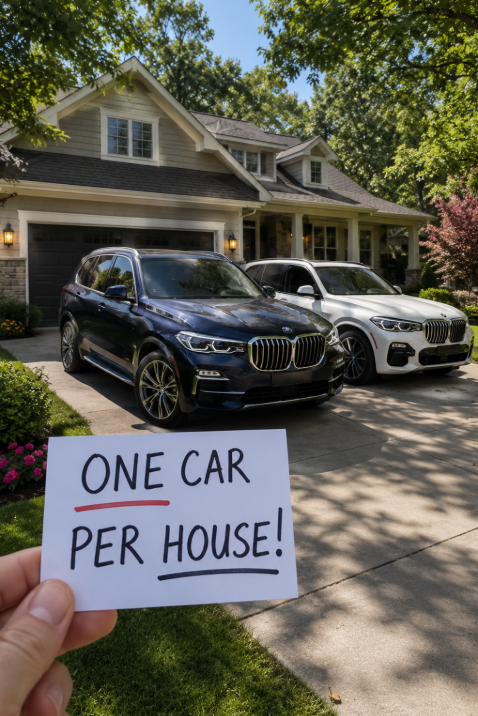
Richard, who prided himself on maintaining a pristine view from his front porch, grew increasingly annoyed by the number of vehicles parked along the public curb. Though the street belonged to the city and was entirely open for legal public parking, Richard decided to unilaterally enforce a brand-new, self-invented mandate: “One car per house.”
Richard took it upon himself to print out aggressive, official-looking notices and tape them directly to the windshields of any neighbor who dared to park a second vehicle on the asphalt. He even went so far as to hold an emergency block meeting in his driveway, cornering residents and explaining that multiple vehicles ruined the aesthetic value of the neighborhood and caused unnecessary traffic congestion.
Mark, who lived with his wife and their college-aged daughter, relied on having three vehicles to handle their daily commutes to work and campus. When Mark calmly explained that his family legally required their cars, Richard threatened to involve the local homeowners association and call code enforcement daily until the street was entirely clear.
Rather than engaging in a shouting match or cowering under Richard’s bullying tactics, Mark decided to execute a brilliant plan of malicious compliance. He spent an evening meticulously reviewing the strict, written bylaws of both the municipal parking authority and their local HOA agreement.
What he discovered was a massive loophole that Richard had completely overlooked in his rush to clear the street. While the public curb was subject to regular street-sweeping schedules and standard city rules, every single property owner legally owned a massive, deep driveway and a side gravel pad that extended well past the front boundary line of their houses.
Mark immediately reached out to the rest of the frustrated neighbors on the block, sharing his legal findings and proposing a coordinated response. The very next morning, the “One Car Per House” rule officially went into effect, but not in the way Richard had envisioned.
Every single neighbor moved their secondary and tertiary vehicles off the public street—and parked them systematically, legally, and strategically along the very edge of their private driveways and lawns, directly bordering Richard’s property line.
Instead of a clean, empty street, Richard woke up to find his view entirely surrounded by a wall of legally parked trucks, SUVs, and compact cars. Because the vehicles were completely on private property, the city and the HOA couldn’t intervene. Richard’s self-righteous plan had backfired spectacularly; by forcing his neighbors off the public asphalt, he had inadvertently transformed his own front yard view into a permanent, cramped parking lot.
Realizing he had completely lost the battle, Richard was forced to quietly retract his rule and apologize to the block, proving that neighborhood bullies almost always stumble when faced with a clever dose of legal compliance.