An original fictional story inspired by the visible scene, with invented names, dialogue, and a continuation beyond the clip.
The Guests They Turned Away
Helen had worn the pearl necklace only three times.
Once at her wedding. Once when her son graduated. And once at his funeral.
That evening, standing beneath the chandeliers with her husband’s arm linked through hers, she touched the clasp and wondered whether coming had been a mistake.
“It’ll be all right,” Peter whispered.
Inside the ballroom, guests were gathering for a charity dinner supporting young people leaving foster care.
Their son, Michael, had helped establish the charity twelve years earlier. After his death, Peter and Helen continued volunteering—driving young people to interviews, furnishing first apartments, answering late-night telephone calls.
Tonight, the invitation said, Michael’s work would be remembered.
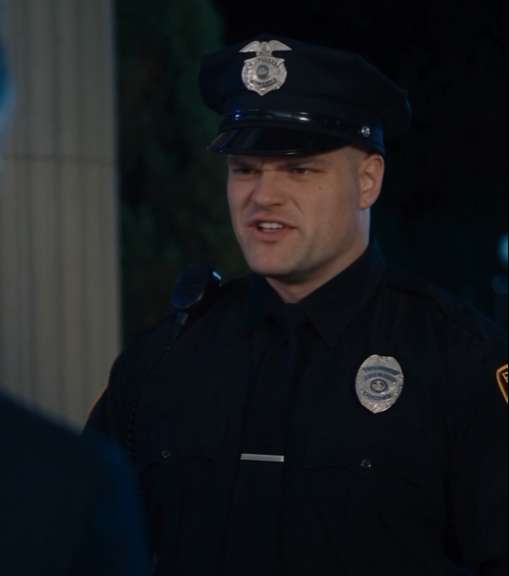
They had barely reached the entrance when a uniformed officer stepped into their path.
“Sir. Ma’am. I need you to come with me.”
Peter stopped.
“Is something wrong?”
The officer held out an arm, keeping them apart from the arriving guests.
“There’s a question about your admission.”
Helen opened her small handbag.
“We have an invitation.”
The officer checked a device in his hand.
“I’ve been told you’re not authorized to attend.”
“That can’t be right,” Peter said.
Several people nearby turned to watch.
The officer’s voice grew firmer.
“Please don’t make this difficult.”
Helen lowered the invitation.
Peter had spent the afternoon telling her how proud Michael would have been to see them there. Now he could feel her fingers tightening around his arm.
“Who told you that?” he asked.
“The event organizer.”
“Then could you ask them to come here?”
“I’m asking you to leave.”
For a moment, Peter stood motionless.
Then Helen looked at him.
“Let’s go.”
He wanted to argue. Instead, he took her hand.
They began walking away while the guests beneath the chandeliers watched.
Behind them, the officer turned back toward the entrance.
A woman in a dark jacket hurried out of the ballroom and stopped directly in front of him.
“What happened to that couple?”
“An admission issue.”
She looked past his shoulder.
“Peter! Helen!”
Neither heard her at first.
She ran after them.
Rachel caught up with them beside the steps.
“Please wait.”
Helen turned, struggling to compose herself.
“We don’t want any trouble.”
Rachel stared at the invitation still in her hand.
“You’re the people I came here to thank.”
Ten years earlier, Rachel had left foster care carrying two bin bags and an address that turned out to be wrong.
Michael had found her sitting outside the charity’s office after closing.
When he couldn’t arrange accommodation that evening, he had called his parents.
Helen made up the spare bed. Peter drove across town to collect her.
Rachel stayed for six weeks.
Now she was a solicitor, a trustee of the charity, and the evening’s main speaker.
She looked toward the officer approaching them.
“Who asked you to remove them?”
He hesitated.
Then he named the charity’s development director, Adrian Cole.
Rachel’s expression changed.
That afternoon, Adrian had told her Peter and Helen were unwell and couldn’t attend.
She found him beside the stage.
“Why did you say they’d canceled?”
Adrian glanced at the microphone in her hand.
“Can we discuss this privately?”
“Were you going to tell me before or after my speech?”
He lowered his voice.
“Peter has been sending accusations to the board. Tonight isn’t the place for a confrontation.”
Rachel knew about the letters.
Peter had asked why the charity’s emergency accommodation fund had shrunk while spending on events and consultancy had increased. He had requested accounts, received vague answers, and asked again.
“So you invited them,” Rachel said, “then had them removed.”
“I was protecting the evening.”
She handed the microphone to a technician.
“Find the chair of trustees.”
The dinner began twenty minutes late.
Peter and Helen sat at Rachel’s table. Nobody asked them to stand for an apology or smile for a photograph.
Before returning to his duties, the officer approached them.
“I should have checked the situation before speaking to you that way,” he said. “I’m sorry.”
Peter nodded.
“Yes. You should have.”
The officer accepted the answer.
During her speech, Rachel told the room about two bin bags, a wrong address, and a bed with clean sheets.
She spoke about Helen leaving the hallway light on because Rachel couldn’t sleep in complete darkness.
She spoke about Peter teaching her to drive in a car with a stubborn second gear.
Then she looked toward their table.
“Michael opened the door for me. His parents kept it open.”
Helen reached for her husband’s hand.
An independent review followed.
Peter’s questions proved justified. Money intended for practical support had been diverted into excessive promotional costs, including payments to a company whose connection to Adrian had not been disclosed.
Adrian was dismissed. The trustees introduced tighter oversight and published a plan to restore the emergency fund.
Peter declined an invitation to join the board.
“I’ve enough meetings at my age,” he said.
But he agreed to help assess what the young people actually needed.
Three months later, Rachel joined him and Helen at a small flat they were preparing for a new resident.
There was no red carpet. No guest list.
Peter was struggling with a curtain rail.
Helen was putting mugs in the kitchen cupboard.
A nervous young man appeared at the open door, holding a suitcase.
“Am I in the right place?”
Helen walked over to him.
“Yes,” she said. “Come in.”