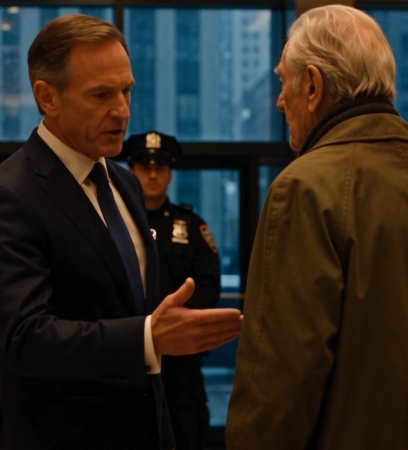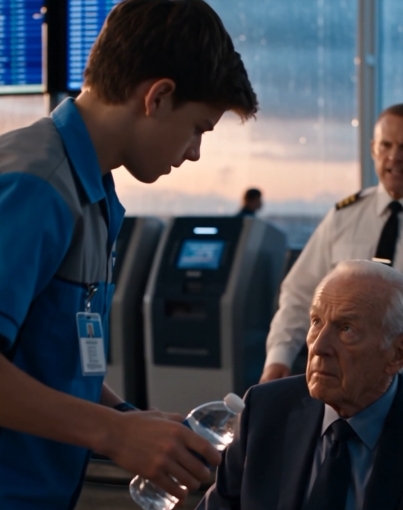
An elderly traveler appears unsteady in an airport waiting area. A young worker in a blue uniform leaves his cart, helps the man sit, and offers assistance. A man in a white uniform shirt approaches and speaks angrily to the worker. The young man then takes a folded paper from his pocket and holds it out.
Extended story:
Noah saw the suitcase fall before he saw the man stumble.
He left his cleaning cart beside the wall and reached the elderly traveler just as the man caught the edge of a chair.
“Let’s sit down.”
The man lowered himself carefully.
“I’m all right.”
“You don’t look all right.”
Noah signaled toward the nearby service desk for help, then crouched so the man could hear him over the terminal announcements.
“What’s your name?”
“Edward.”
“I’m Noah. Someone’s coming.”
His shift supervisor arrived first.
“Why have you left your section?”
Noah looked up.
“He needed help.”
“There are staff for that.”
“I’ve called them.”
The supervisor glanced at the cart.
“You’ve been warned about leaving your assigned area.”
Noah stood.
He was nineteen, still on probation, and three weeks behind on rent. He had spent that morning hoping his supervisor would sign the form in his pocket.
Now the man was pointing toward the service corridor.
“We’ll discuss your future here after your shift.”
Noah took out the folded paper.
His supervisor looked at it.
“What’s that?”
“The training application I asked you about.”
He held it out.
“You can keep it.”
The supervisor stared at him.
“Are you resigning?”
“No. I’m helping him. If that costs me your recommendation, I understand.”
It wasn’t how Noah had imagined the sentence coming out.
His voice shook on the last word.
Before the supervisor could answer, an airport assistance worker arrived with a colleague. They took over, asked Edward questions, and arranged for him to be checked.
Noah retrieved his cart.
He still had four hours left.
At the end of the shift, his supervisor called him into a small office.
Noah expected a warning.
Instead, the airport’s passenger-services manager sat beside the desk.
She had spoken to the assistance team and two nearby travelers.
“Tell me what happened,” she said.
Noah did.
He explained where he left the cart, who he contacted, and why he stayed.
She listened, then asked about the folded application lying on the desk.
He wanted to train in passenger assistance.
“My grandmother used to travel alone,” he said. “I always hoped someone would notice if she needed help.”
The manager turned toward his supervisor.
“We need to be clear about how staff report and respond to situations like this. Leaving a task briefly to call assistance isn’t the same as abandoning a shift.”
Noah watched his supervisor’s expression.
For once, the man had no immediate reply.
Edward returned to the terminal two weeks later.
He carried a letter, but he wasn’t an airline owner, a board member, or anyone who could offer Noah a spectacular reward.
He was a retired bus driver who had been frightened and alone.
“I asked where I could leave a compliment,” he told Noah. “They said to put it in writing.”
Noah read the first line.
Your employee noticed me when I needed someone to notice.
He folded the letter carefully.
“Thank you.”
Several weeks later, he was accepted into the airport’s passenger-assistance training program. There were interviews, assessments, and a great deal to learn. Edward’s letter became part of his application.
On his final cleaning shift, the supervisor handed back the recommendation form.
It was signed.
“I handled that badly,” he said.
Noah looked at him.
“Yes. You did.”
“I’m sorry.”
Noah nodded, tucked the form into his pocket, and went to finish his section.
His new uniform wasn’t ready yet.
But he had already begun learning the job.