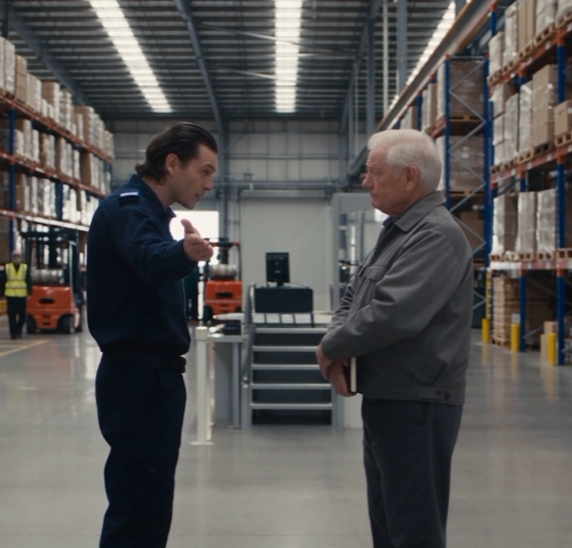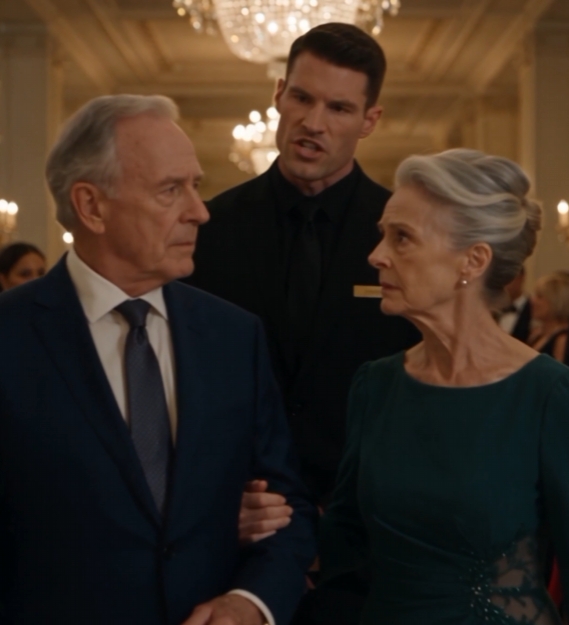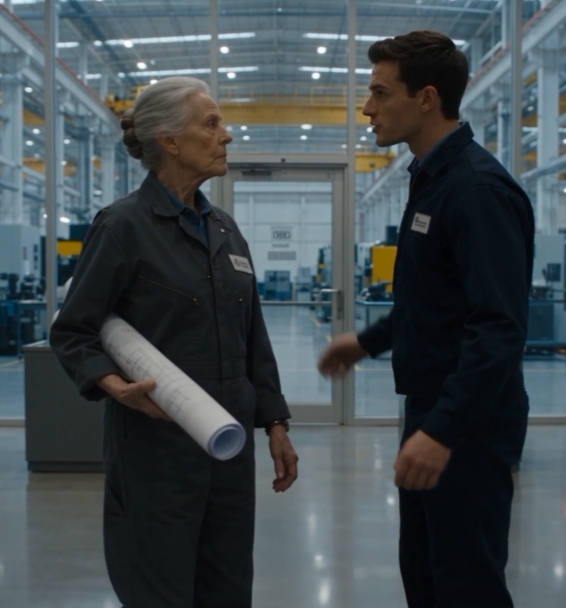
In a warehouse aisle, a younger worker faces an elderly man carrying a folder. A professionally dressed woman approaches and addresses the older man as “Mr. Parker.” The visible captions indicate that a team is waiting and refer to an independent assessment and starting with communication. The younger worker remains beside them as the exchange shifts.
What happens next:
The warehouse supervisor had expected an inspector in a tailored suit, accompanied by people carrying tablets.
Instead, an older man arrived alone with a battered folder.
Mr. Parker asked where he should report. The supervisor answered impatiently, then turned away before he could finish explaining.
When the operations director arrived and greeted the visitor, the supervisor immediately stood straighter.
Mr. Parker noticed.
He also noticed a young packer waiting nearby, holding a damaged carton. Twice, she tried to get the supervisor’s attention. Twice, he motioned for her to wait.
“Before we begin,” Parker said, “what does she need?”
The supervisor shrugged. “Probably another minor problem.”
Parker turned toward her.
“Show us.”
Several cartons from the same delivery had arrived damaged. She had tried to report it earlier, but the shipment was already being prepared for dispatch.
The director asked for the affected pallets to be checked.
The supervisor stared at the carton. What he had dismissed as an interruption had nearly become a costly mistake.
Inside the office, he asked Parker whether the incident would appear in his report.
“Yes.”
“Am I going to lose my job?”
“That isn’t my decision,” Parker replied. “But what you do next matters.”
The supervisor returned to the floor and gathered his team.
He apologized to the packer in front of everyone who had heard him dismiss her. Then he asked what else people had been trying to tell him.
For several seconds, nobody spoke.
Finally, one worker raised a hand.
Parker opened his folder.
The assessment had properly begun.