What happens in the video:
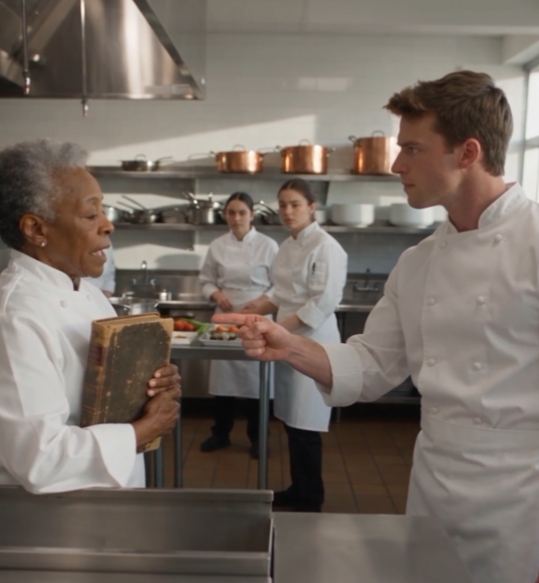
An older woman wearing a chef’s jacket holds an aged brown book in a professional kitchen. A younger chef gestures towards her and the book during a tense exchange. Other workers observe. A woman in a dark suit approaches carrying another item and joins them near the end. The book’s significance is not shown.
Continuation:
Celia refused to leave the book on the wet counter.
“Give me a clean space,” she said.
The young chef mistook her caution for an attempt to delay the discussion.
“We’re trying to prepare for service.”
“So am I.”
He had been told that a visiting cook would help with a special menu. Nobody had explained why she was carrying a book that looked as though it belonged in an attic.
When he suggested using the restaurant’s printed recipes instead, Celia tightened her grip.
“These are the recipes I was asked to bring.”
The manager arrived before the disagreement could go further.
She cleared a dry table, then asked Celia to open the book.
Inside were recipes collected by women who had cooked together at a neighbourhood centre for almost forty years. Some pages were written in different hands. Others carried notes about portions, substitutions and occasions.
The restaurant was hosting a fundraising dinner for that centre, which needed repairs. Celia had volunteered to help recreate its best-loved meals.
The young chef, Marcus, had understood the event as an opportunity to design a new menu.
Now he saw the problem.
“I thought we were starting from scratch.”
Celia touched the edge of a page.
“We’ve already done quite a lot of starting.”
Marcus apologised. She accepted, but asked that they treat the book carefully. Several contributors were no longer alive, and their handwriting mattered as much as their ingredients.
They agreed to make working copies.
As they cooked, Marcus asked questions. Why was one quantity crossed out? Why did another recipe have three different names?
“Because nobody agreed,” Celia said. “We cooked together anyway.”
He laughed.
On the evening of the fundraiser, the dishes went out with short descriptions of the people who had contributed them. Guests recognised a neighbour’s stew, a grandmother’s pudding, a bread they hadn’t tasted in years.
Celia watched an older man take his first spoonful and quietly wipe his eyes.
Marcus saw it too.
After service, he asked whether she would allow the team to help create a printed collection, with permission from the contributors and their families.
The project took months. Names were checked, stories gathered and measurements tested.
At the launch, Celia placed the original book beside the new edition.
Marcus had expected her to be pleased by the clean pages.
Instead, she opened the old volume and pointed to a stain.
“That was the day the roof leaked into our custard.”
He grinned.
“Should we have included that?”
“In the second edition.”
She closed the cover gently, then picked up the new book. There was room in the kitchen for both.